See every note. Hear every position.
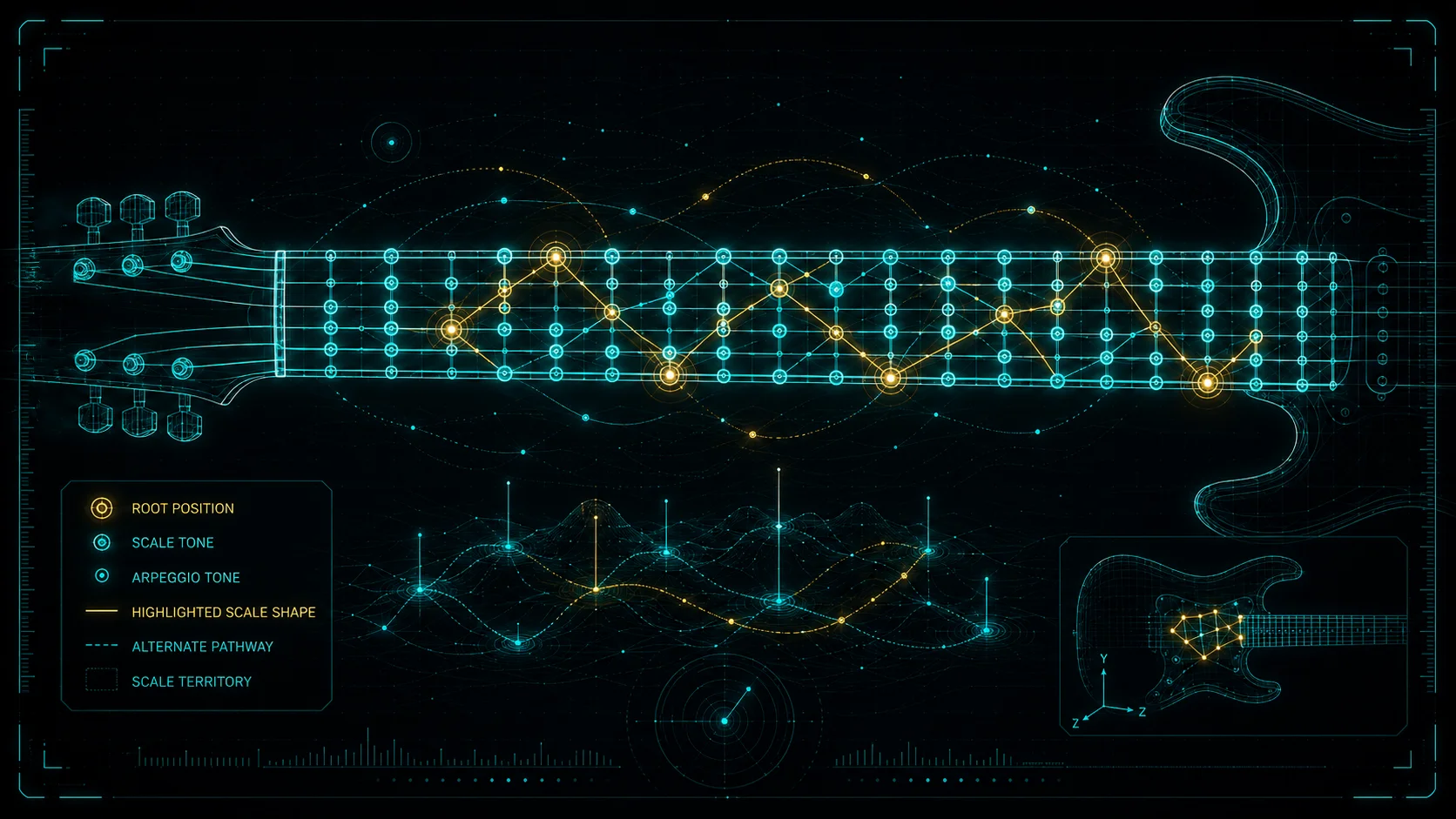
Pick a root and a scale or arpeggio. Every note lights up across the whole neck — tap any dot to hear it.
Know where your scales live — now find every individual note on the neck with the Note Finder, or keep your guitar in tune and your time locked in with the Intonator and Metronome.
Why the whole neck at once
Most of us learn scales one box at a time. It works at first, then quietly becomes the ceiling — you can play the shape, but you can't get out of it, and the notes above and below feel like someone else's territory.
Seeing every note at once fixes the mental map. The same five or seven notes repeat all over the neck, and once you can see that, the boxes stop being separate rooms and start being doors between the same places.
That's what the position filters are for. Show all when you want the map. Narrow to CAGED, a string set, or three-notes-per-string when you want somewhere to actually put your fingers today. The map first, then one small piece of it.
Overlay questions, answered
What's the difference between a scale and an arpeggio here?
A scale gives you every note in the key. An arpeggio gives you only the notes of the chord. Same neck, fewer dots — which is why arpeggios tend to sound more “inside” over a chord change.
Why do so many notes light up?
Because they genuinely are all there. A six-string neck repeats the same handful of notes dozens of times. Switch to degrees and the repetition becomes a pattern instead of noise.
Should I use note names or degrees?
Note names train the fretboard. Degrees train your ear and your theory. Most people benefit from switching back and forth rather than picking one.
What do Solo String and Ghost Fill do?
Solo String hides everything except the one string you pick, which is a nice way to learn a scale horizontally instead of in boxes. Ghost Fill fades the rest of the scale in behind whatever you're focused on, so you can see how one position sits inside the whole neck. They work together, and on top of any position you've chosen.
What are 3NPS and 4NPS?
Three or four notes per string. They're alternative ways of slicing the same scale, and they suit legato and picking runs better than the CAGED boxes do.
Does it handle 7 and 8 strings?
Yes, and the extra strings follow the same layout.