Practice Guide
How to Find the Notes on the Fretboard Faster
You do not need to memorize every note on the neck one by one. Learn a few landmarks and patterns that make the fretboard much faster to read.
We have all been there. You are reading a chord chart, jamming with a friend, or following along with a lesson video, and someone says "Play an F sharp on the D string." Suddenly your brain has to do a tiny sprint.

Trying to memorize every note on the fretboard one at a time can feel overwhelming. The good news is that you do not need to treat the neck like a giant flashcard deck. A few simple landmarks and patterns make it much faster to find any note without freezing up.
Learn the natural boundaries
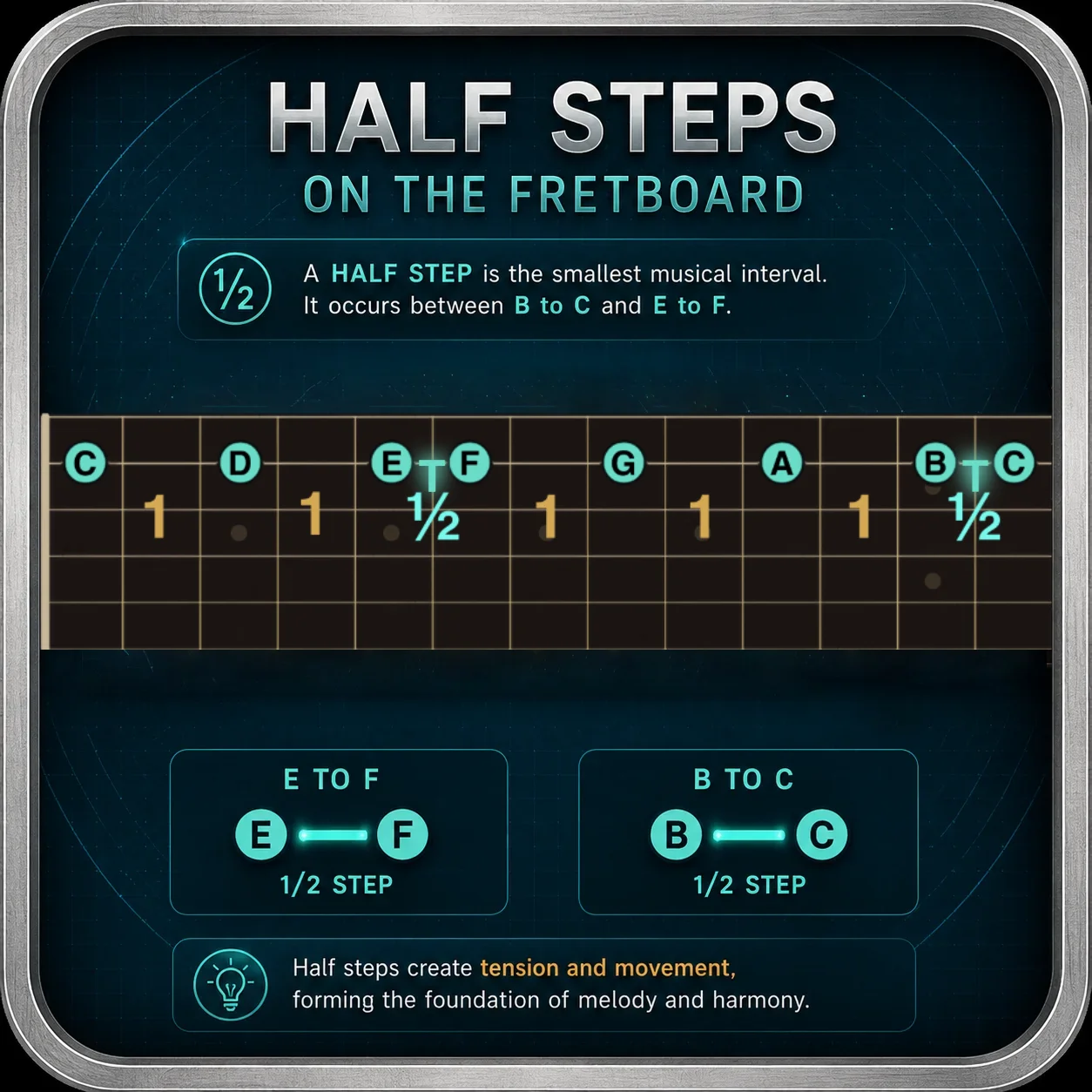
The easiest way to speed up is to understand the natural half-step boundaries in music. Most notes on the fretboard follow the usual sharp and flat pattern, but B to C and E to F do not have a note between them. Those two gaps are your fastest landmarks.
Once you know that, you stop counting blindly and start recognizing structure. If you spot a B or an E on the neck, you immediately know the next natural note without having to think through the whole alphabet. That saves a surprising amount of time when you are under pressure.
No sharp between them. One fret apart, no matter where they appear on the neck.
Same rule. Find an E and you know exactly where F lands — one fret higher, every time.
Use the 12th fret mirror
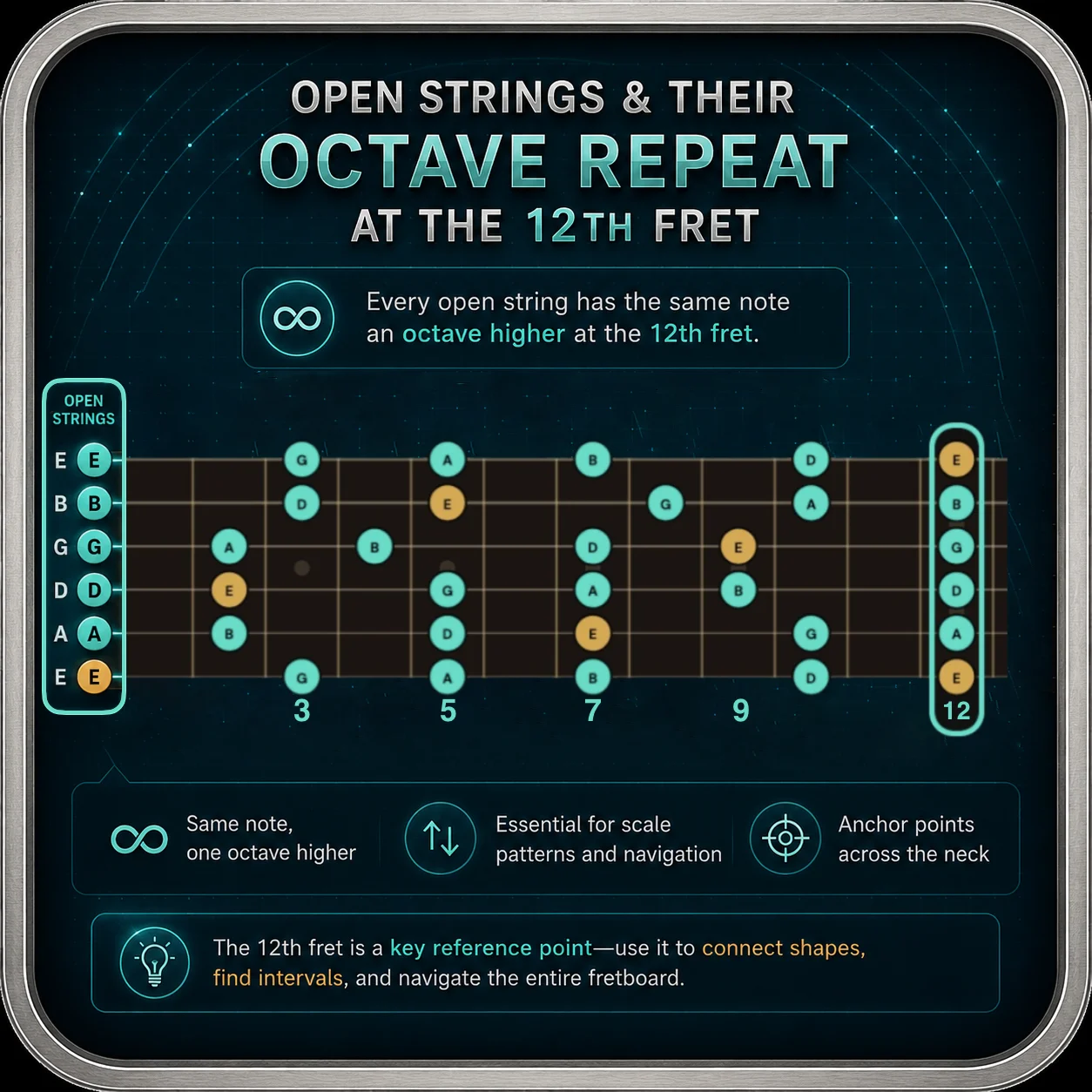
The 12th fret is one of the best landmarks on the whole guitar. It is the octave point, which means the open strings repeat there. If you know the notes on the open strings, you already know their octave names at the 12th fret.
That also means anything you learn below the 12th fret carries upward. If you know where an A lives on the 5th fret of the low E string, you also know where another A lives above the 12th fret. The fretboard becomes a lot less intimidating once you realize the first 12 frets already give you most of the map.
Use octave shapes
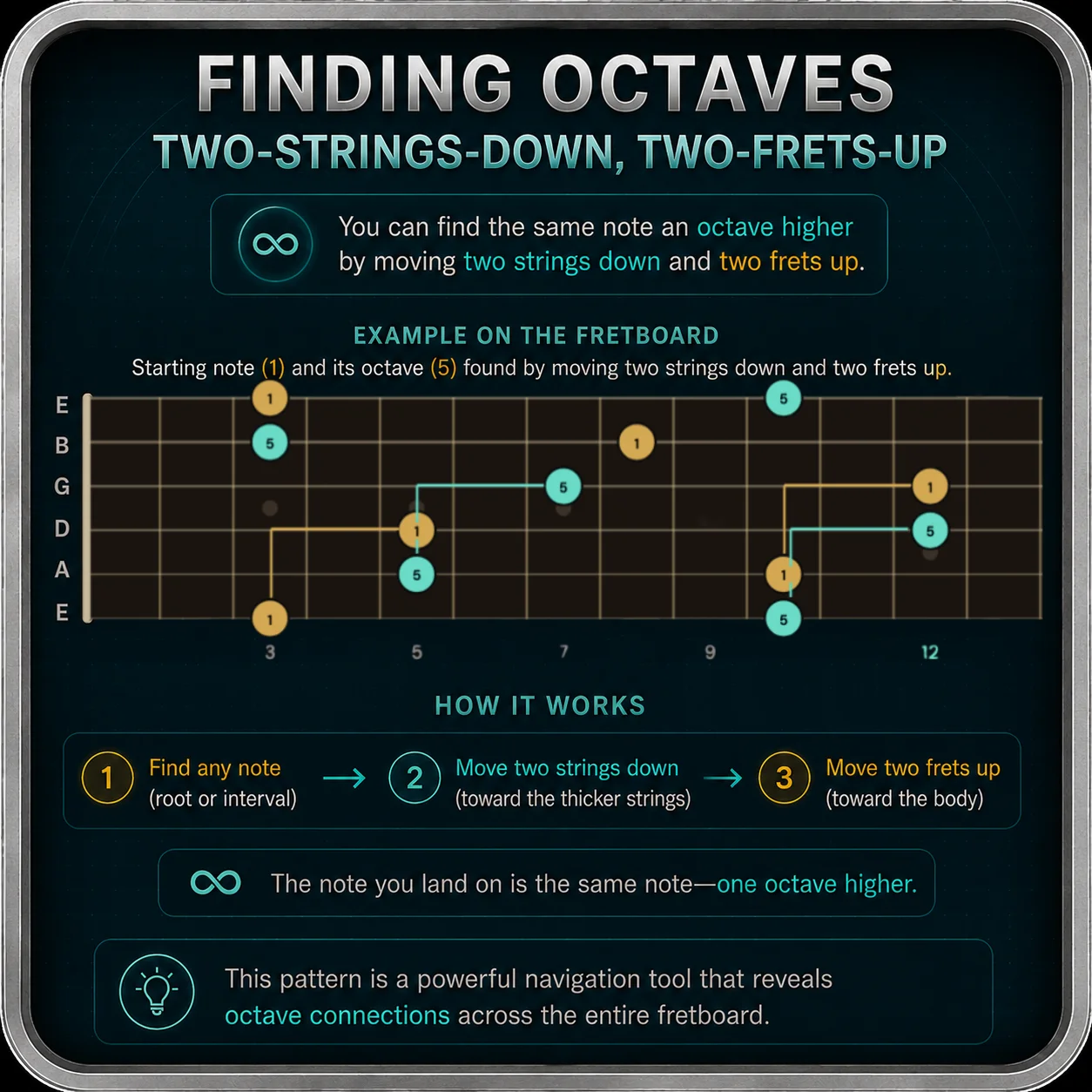
The fastest way to find a mystery note is often to anchor it to one you already know. On guitar, octave shapes repeat in predictable ways. One of the simplest is the two-strings-down, two-frets-up move.
If you know a note on the low E or A string, you can often jump to its octave on an inner string almost instantly. That turns the fretboard into a network of relationships instead of a pile of isolated positions. Once that clicks, note finding gets much faster.
Stop counting every fret
A lot of players get stuck because they try to count from the open string every single time. That works, but it is slow. The better habit is to use landmarks: natural half steps, octave mirrors, and known anchor notes.
The more often you practice finding notes with those anchors, the less you need to count at all. That is how the fretboard starts to feel readable in real time. You are not guessing — you are using structure.
Use the Note Finder
This is exactly what the Fretboard Note Finder is for. Instead of staring at a static chart, you can click a note or fret and see the answer immediately. That makes practice feel interactive and helps the neck start to stick in your memory.
If you want to memorize the fretboard faster, the tool is a great daily shortcut. A few minutes of active clicking usually does more than a long session of passive reading.
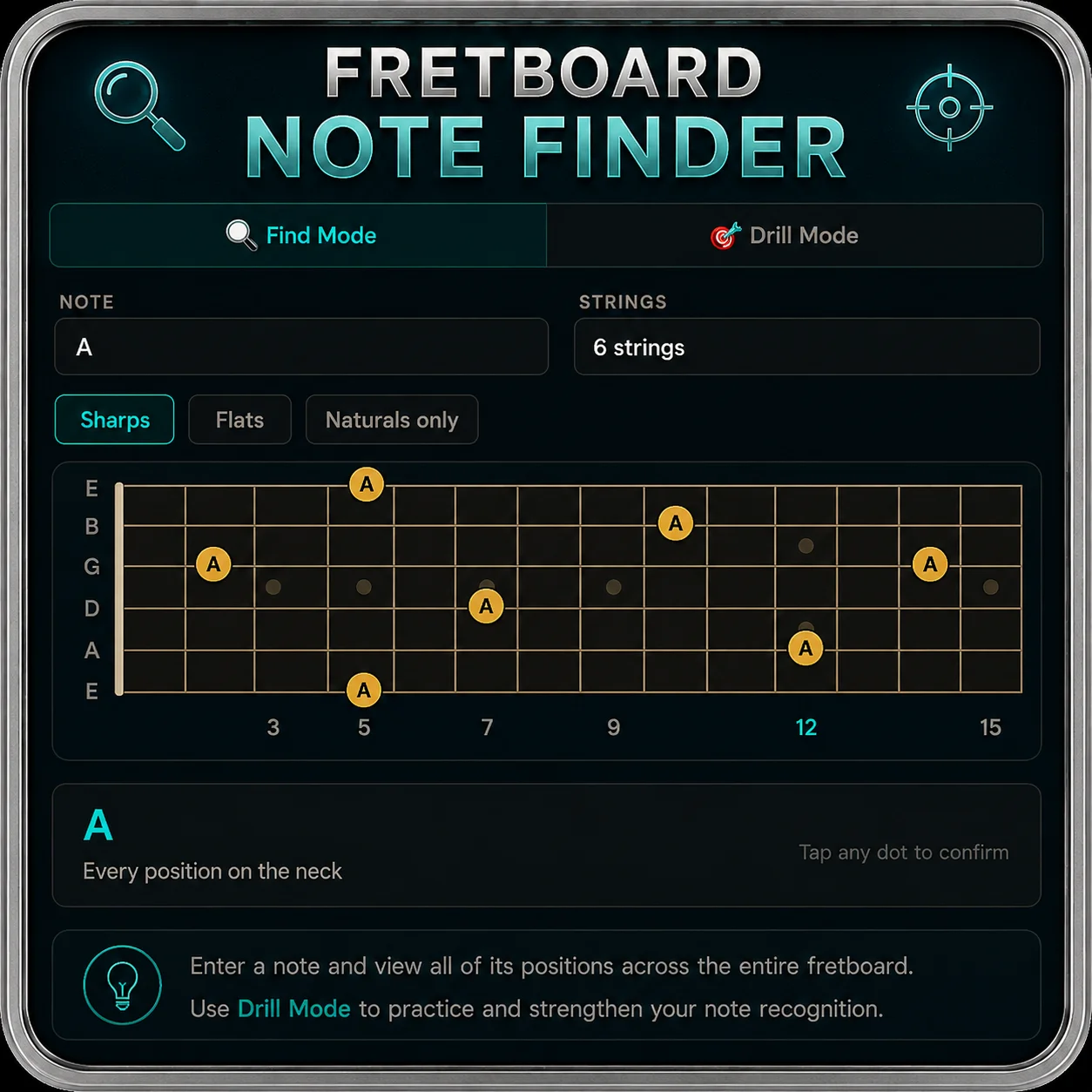
Want a faster way to spot every note? Open the Fretboard Note Finder and use it as an interactive cheat sheet while you practice.
Open the Note Finder →The Pocket Roady order
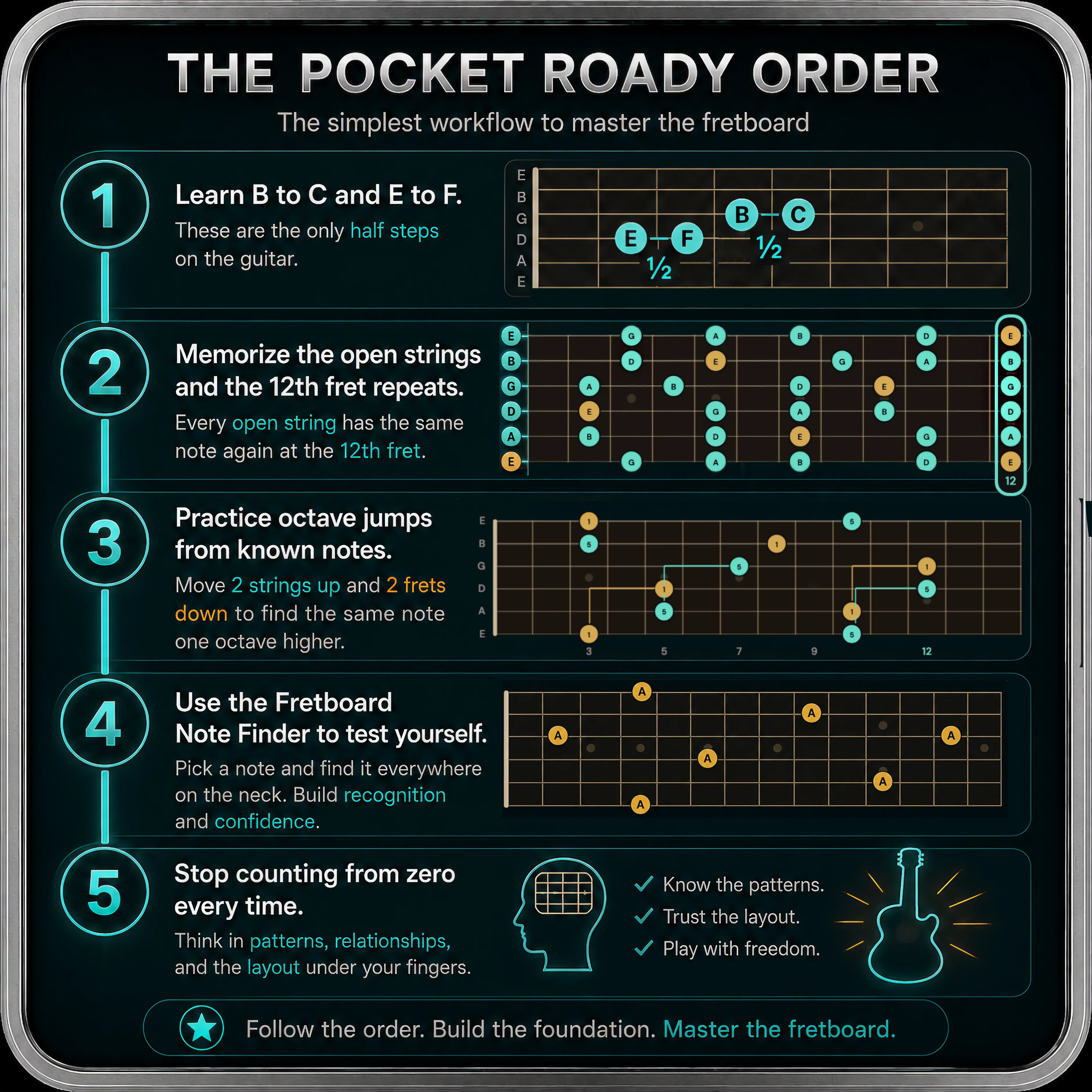
Here is the simplest workflow — start at the top and work your way down:
Learn B to C and E to F. These natural boundaries are your fastest landmarks anywhere on the neck.
Memorize the open strings and the 12th fret repeats. Six notes, and you have anchors at both ends.
Practice octave jumps from notes you already know. Two strings down, two frets up — one of the most reliable shapes on the neck.
Use the Fretboard Note Finder to test yourself. Click any position and see if you were right before the answer appears.
Stop counting from zero every time. Reach for a landmark first, then fill in the gaps.
That keeps the process practical and fast. The fretboard is much easier to read once you treat it like a map of relationships instead of a list of random notes.
Where to go next
If you want to find notes on the fretboard faster, the goal is not perfect memorization on day one. It is building a few reliable shortcuts that make the neck feel familiar under pressure. Start with the boundaries, add the octave shapes, and let the Note Finder do the drilling while you focus on playing.
Want a faster way to spot every note? Open the Fretboard Note Finder and use it as an interactive cheat sheet while you practice — or keep going and see how notes connect as scales and arpeggios.