Relief
Nut
Action
Intonation
Setup
Pocket RoadyTool Stack Deluxe
Power
Guitar Ear Trainer
Train the ear behind the hands.
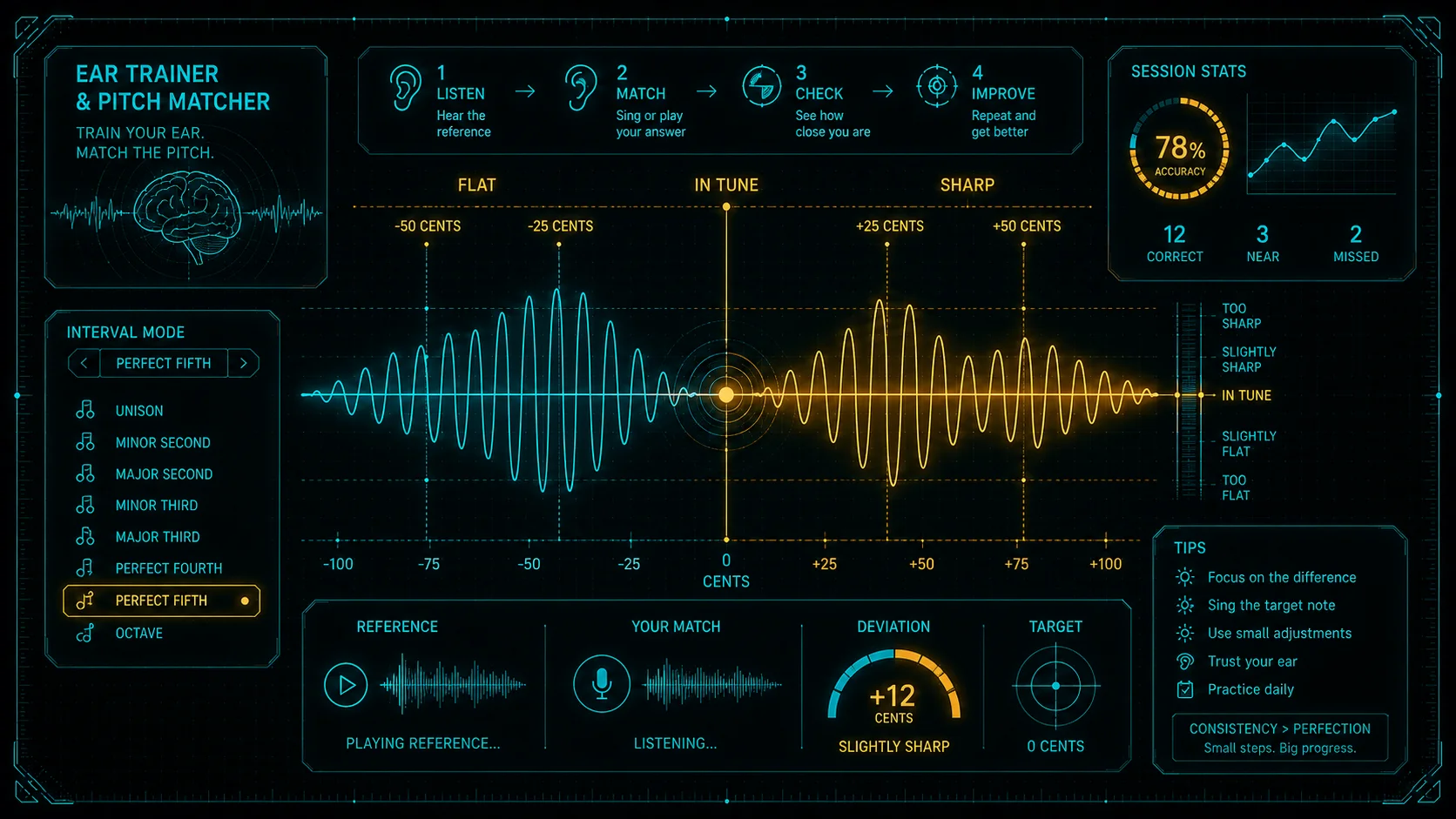
Four listening drills — intervals, notes, chords, and scale degrees — plus a live pitch matcher that scores your guitar or voice in cents.
No download needed · Works in any browser
The "Hear It, Then Play It" Method.
A tuner keeps your strings honest, but it can't hear you — whether you're bending in tune or landing on the right note. That's the ear's job. These four drills sharpen the part of you that catches a sour note before any meter does, and the pitch matcher closes the loop: hear a tone, then play it back until it lands.
Interval recognition
Two notes play in a row. Name the distance between them.
Level
Press play to hear the first one.
0
Streak
0
Best
—
Accuracy
0
Answered
Reference tone:
🎸 ROADY HINT
Sing along. The fastest way to lock an interval in is to hum the lower note, then slide up to the higher one. Your voice teaches your ear faster than your eyes ever will.
A trained ear is the other half of good intonation. Once you can hear when a note is off, check whether your guitar agrees.
Questions about ear training
Do I need perfect pitch?
No — and almost nobody has it. This trains relative pitch: hearing how notes relate to one another. Every drill gives you a reference first, so you're always judging distance and quality, never naming a note out of thin air. Relative pitch is a skill that grows with practice.
How does the pitch matcher work?
A target tone plays, and your mic listens as you match it on your guitar or with your voice. The meter shows how far off you are in cents — flat to the left, sharp to the right — and turns green when you hold it in tune. Match the note in the octave shown.
What's a cent?
A cent is one hundredth of a semitone — the small step from one fret to the next. There are 100 cents between any two neighbouring notes, so an octave spans 1,200. Most ears start to notice a difference around 5 to 10 cents, which is the window the meter treats as in tune.
How is this different from a tuner?
A tuner tells you whether a string sits at its target. The matcher trains the link between ear and hands — you hear a tone first, then try to produce it. It's about playing what you hear. If you just need to tune up, the Guitar Tuner is the right tool.
Is my microphone audio sent anywhere?
No. The mic is used only by the pitch matcher, and all listening and analysis happens on your own device. Nothing is recorded, stored, or transmitted.