How Fretboard Radius Affects Your Setup
Your fretboard isn't flat. It curves gently across its width, and that curve quietly shapes how low your action can go, how your bends feel, and how your bridge should be set. Here's what it means — in plain terms — and where it fits into a clean setup.
Most players never think about radius, and that's completely fine. You can play for years without knowing the number. But once you start setting up your own guitar, it's one of those quiet details that explains a lot: why one string buzzes while its neighbor sits high, or why a guitar that feels great for chords seems to fight you on big bends.
What "radius" actually means
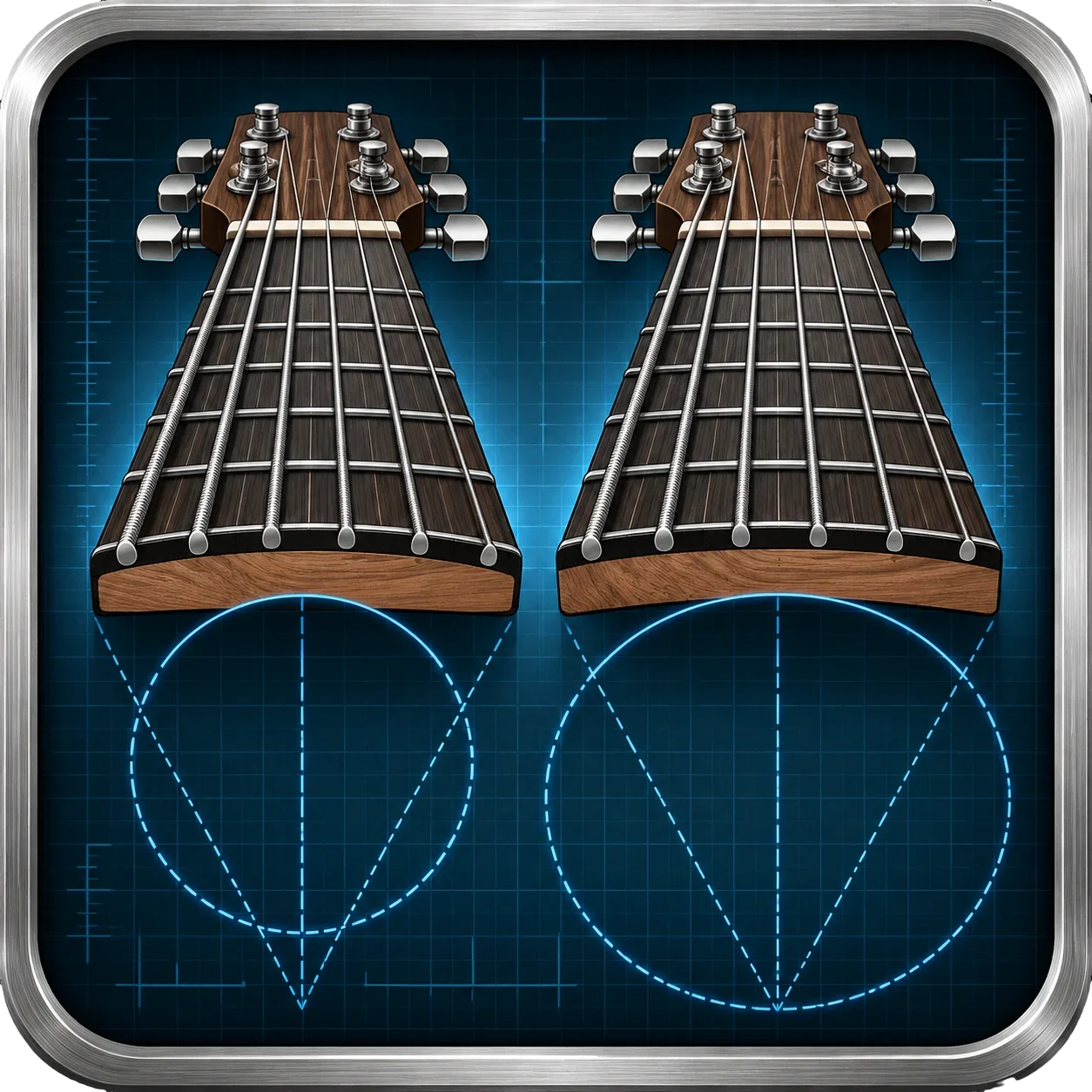
Picture the curve of your fretboard continuing all the way around into a full circle. Fretboard radius is just the size of that imaginary circle, measured in inches. A smaller number means a rounder, more curved board. A larger number means a flatter one.
A few common ones you'll run into:
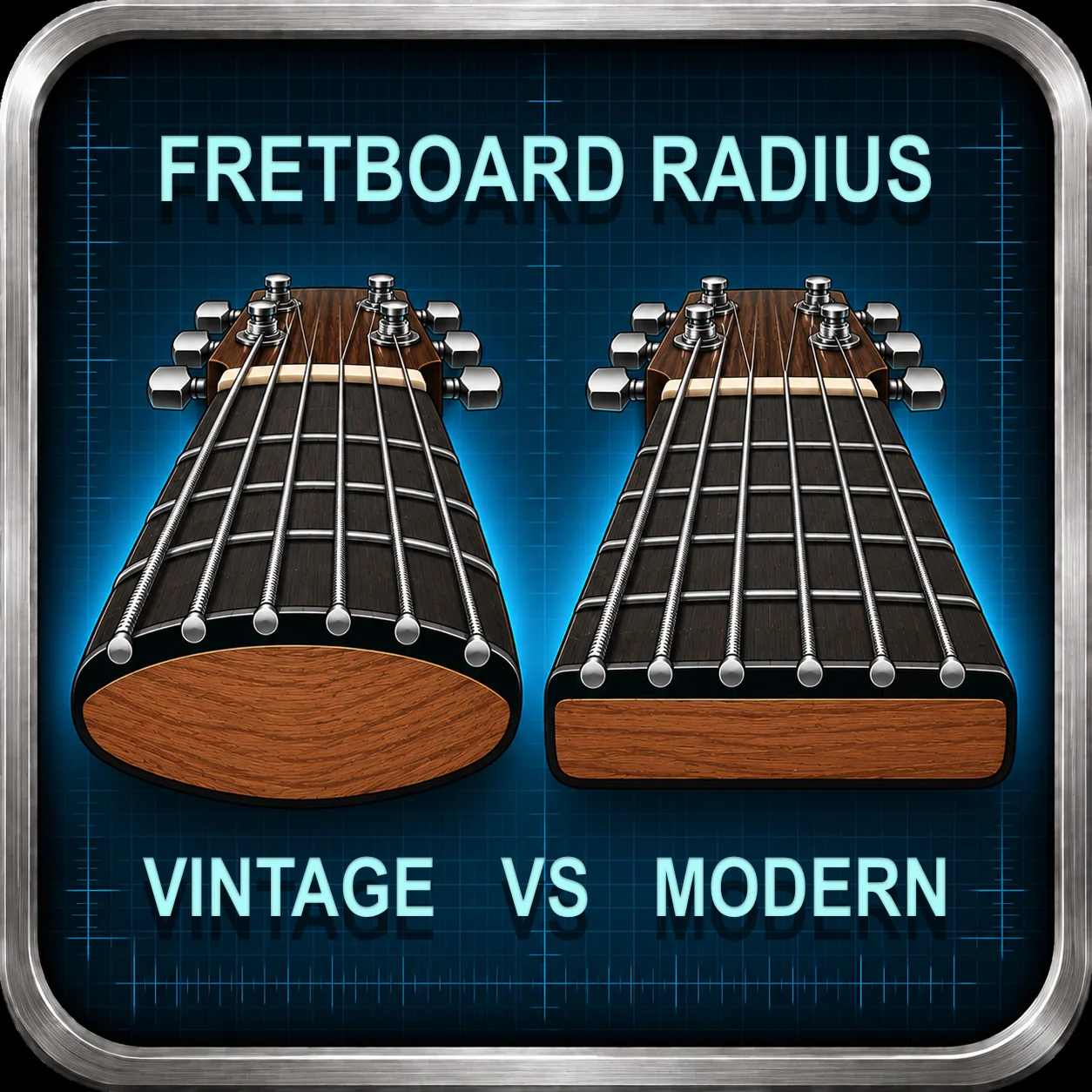
- 7.25" — vintage Fender. Quite rounded, comfortable under the hand for chords.
- 9.5" — modern Fender. A gentle, all-rounder curve.
- 10" – 12" — many PRS and Gibson-style guitars. Flatter, a touch more modern.
- 16" and up — flat, fast necks built for low action and big bends.
Some guitars use a compound radius — rounder near the nut and flatter up toward the higher frets. More on that in a moment.
You usually don't need to measure. Knowing your guitar's make and model gets you the radius in seconds — the Fretboard Radius Matcher has the common ones built in. If you want to be exact, a radius gauge held against the board confirms it.
Why the curve matters for your action
Here's the heart of it. Because the board is curved, the strings don't all sit at the same height off a flat line — the outer strings sit a little lower than the strings in the middle. For your action to feel even across all six strings, your bridge saddles need to follow that same curve.
If the saddle heights don't match the board, the action gets uneven. Set the saddles too flat against a curved board and the middle strings end up a touch high while the outer ones risk buzzing — or the other way around. Nothing dramatic, but it's the difference between a setup that feels balanced and one where one or two strings always seem a little off.
The good news is the amounts are small and predictable. On a typical 9.5" board, the outer strings sit only about a millimetre and a third lower than the center pair. You don't have to work that out by hand — the Fretboard Radius Matcher gives you the exact per-string offsets so you can match your saddles to your curve before you touch the bridge.
Radius and how your guitar feels

Radius also shapes the playing feel, and this is where personal taste comes in — there's no single "best" number, just trade-offs.
Flatter boards (12", 16") let you set the action lower and bend strings a long way without the note choking out. That's why a lot of lead-focused and modern necks lean flat.
Rounder boards (7.25", 9.5") tend to feel cozy and familiar for chording and rhythm playing, and many players love that vintage feel. The trade-off is that if you set the action very low, big bends on a rounded board can sometimes fret out — the string climbs into the rising curve and chokes. It's not a flaw, just something to keep in mind when you're chasing the lowest possible action.
Neither is better. A rounded board set sensibly plays beautifully, and a flat board is no guarantee of a great setup on its own. It's just helpful to know which way your guitar leans.
Where radius fits into a setup
Radius is one piece of a connected system. A setup goes best in a sensible order — neck relief first, then the nut, then action, then intonation — and matching your saddle curve to the board sits right alongside setting your action height. You get the curve right, then dial the overall height to taste.
So the natural next step after matching your radius is setting your action — how high the strings sit overall. The two go hand in hand: the radius decides the shape of the arc, your action decides how high the whole arc sits.
This all applies most directly to guitars with individually adjustable saddles — Strat, Tele, Floyd Rose, most modern bridges — where you can set each string's height.
On a fixed-radius bridge like a Tune-O-Matic, the saddle curve is set at the factory (around 12"). You can't dial individual strings without swapping saddles, so for those guitars this is more about understanding what your bridge is already aiming for than adjusting it.
A quick word on compound radius
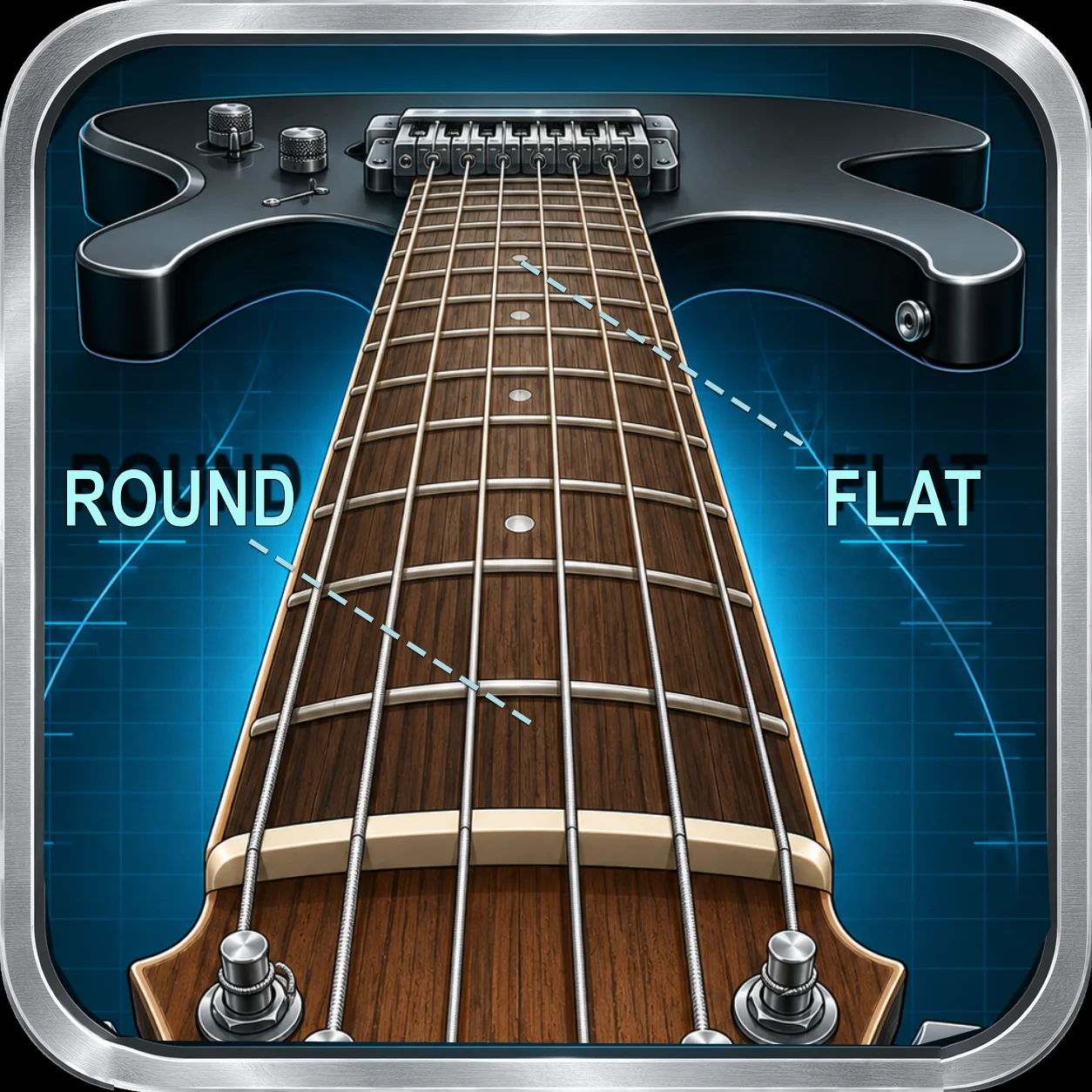
A compound-radius neck changes its curve along its length — rounder near the nut, where you're forming chords, and flatter up high, where you're bending and soloing. It's a clever way to get the comfortable feel of a rounded board and the low-action, choke-free bends of a flat one.
For setting your saddle heights, what matters is the radius down at the bridge end, which is the flatter of the two figures. If your neck is listed as something like "10" to 16"," you'd match your saddles to roughly the 16" end.
Ready to match yours?
Pick your radius, enter your string spread, and get the exact per-string saddle offsets for an even arc.
Try the Fretboard Radius Matcher Next step: set your overall string height with the Action Calculator, or see the full picture in the Setup Assistant.