
Guitar Nut Height 101: How to Check First-Fret Stiffness and Open-String Buzz
If first-position chords feel stiff, sharp, or harder to fret than they should, the nut may be part of the problem. If open strings buzz or sound thin, the nut may be cut too low instead.
The good news is that nut height is pretty easy to check once you know what to look for. You do not need to guess wildly, and you do not need to start filing before you understand the result.
Nut height affects the strings in the first position most noticeably, so it is one of the first places to check when the guitar feels "off" near the headstock.
💡 Not sure if the nut is actually the problem?
If your guitar feels off but you're not certain where to start, the Setup Assistant walks you through the full chain in the right order — starting at the neck.
What the nut does
Think of the nut as the starting point for the strings at the headstock end of the guitar. When the slots are too high, the strings sit too far above the first fret and the guitar feels stiff in first position.
When the slots are too low, the string can start buzzing on the first fret when played open. That usually means the slot is already too deep, not just "a little off."

A high nut can make first-position playing feel hard and sharp, while a low nut can create open-string buzz. That is why the first-fret area is worth checking before you start changing bridge height.
The quick 3rd-fret test
A simple first check is the 3rd-fret test. Tune the guitar to pitch, fret the string at the 3rd fret, and look at the space over the 1st fret.
You are looking for one of three things:
- A clear gap — which usually suggests the nut is too high.
- A tiny hairline gap or a soft click when tapped — which usually means the nut is close.
- The string touching the 1st fret — which usually means the slot is too low.
If the gap is so small that it is hard to see, a light tap on the string can help. A tiny click usually means there is still clearance there.
If you cannot clearly see the gap, the tap test is a useful sanity check. If there is clearance, you should hear a tiny click. If there is no click and the string is already touching, the slot is likely too low.
Measured check
If you want a more exact read, use a feeler gauge. With the guitar tuned to pitch, place the gauge on top of the 1st fret and check the space under the string.
A practical starting point is roughly .020 inches on the wound strings and about .018 inches on the plain strings for electric guitars. In metric, that is about 0.51 mm and 0.46 mm respectively.
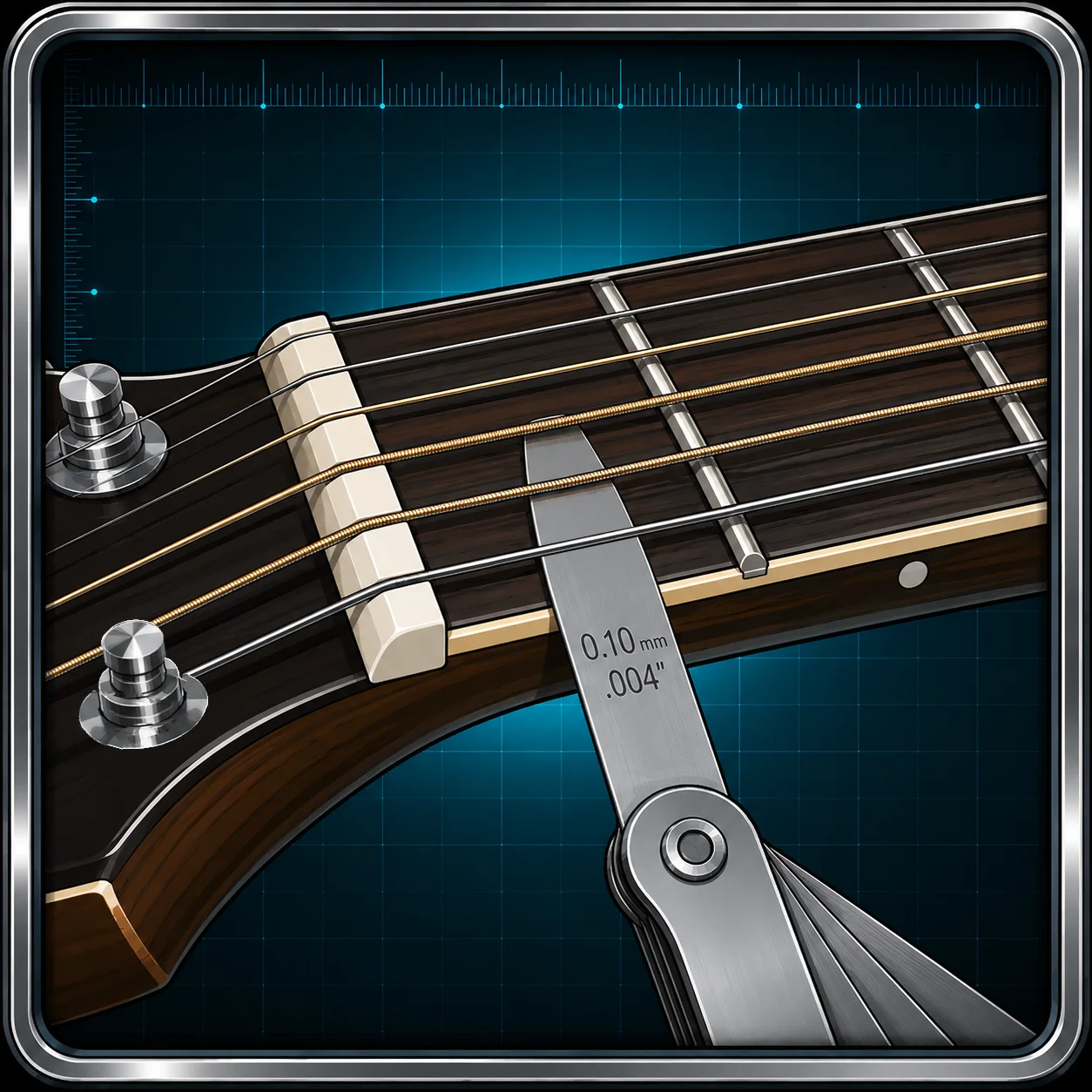
Acoustic guitars typically run a little higher — around .023 inches on wound strings is common. Classical guitars with nylon strings can run higher still. These numbers are practical midpoints, not hard rules.
Use the feeler gauge for precision, but do not let the lack of one stop you from checking the nut at all. A rough test is still better than guessing.
How to read the result
| What you see | What it means | What to do |
|---|---|---|
| Clear gap at the 1st fret | Nut is likely too high | Cautious filing may help |
| Tiny hairline gap or faint click | Nut height is close | Leave it alone, move on |
| String touches the 1st fret | Slot is likely too low | Stop — reassess before filing |
Too high
If the string sits noticeably above the 1st fret, the nut slots are likely too shallow. That can make first-position playing feel stiff and make the guitar seem harder to fret than it should.
About right
If you see a tiny gap or hear a faint click, the nut is probably close enough for a first-pass setup check. In many cases, that means you do not need to touch it right now. If the guitar still feels slightly off, check the neck relief or action next — those are more likely the culprit.
Too low
If the string touches the 1st fret when open, the slot is probably too deep. At that point, stop and reassess before taking any more material off the nut.
Nut work is one of those setup jobs where "close enough" is often the smart answer. If the result already looks good, leave it alone and move on.
What to do next
If the nut is too high, the next step is a careful filing pass with proper nut files. Go slowly and recheck often so you do not overshoot the correct height.
If the nut is already close, leave it alone and move on with the rest of the setup. Nut work is one of those places where chasing "perfect" can create more problems than it solves.
If the nut is too low, that is the caution point. You should not keep filing once you are already touching the first fret.

⚠ Know when to stop
The safest mindset is simple: measure first, file slowly, recheck often. That keeps a small setup job from becoming a repair. If the nut is already too low, replacement or shimming is the right call — not more filing.
The safest mindset is simple: measure first, file slowly, recheck often. That keeps a small setup job from becoming a repair.
Want a quicker read on what your nut actually needs? The Nut Slot Helper walks you through the check and gives you a clear result in about 2 minutes.
Try the Nut Slot Helper →More of the Setup Chain