Where should your pickups sit?

Get a safe starting height for your pickups based on type and position.
Find your starting height
Three quick questions and you will have a safe starting point. These are reference values — always adjust by ear after.
What type of pickup?
Choose the pickup type you are setting up.


Which position?
Select the pickup position you are adjusting.
Choose your unit
Pick the measurement unit that matches your ruler or gauge.
- These are starting-point values, not final truth. Adjust by ear after confirming output balance.
- If you hear warbling, false harmonics, strange buzz, or choking sustain, lower the pickup slightly.
- Pickup makers may specify different starting points for their own models — always check the spec sheet.
What pickup height actually changes
Pickup height sets how much of the string's magnetic field the pickup sees. Closer means more output, more midrange, and a tighter attack. Further away means less output, but often more clarity and a more open top end.
Most people move pickups to chase volume. The more useful reason to move them is balance — getting your bridge and neck pickups to feel like the same guitar when you flip the switch, and getting the bass and treble sides of each pickup to sound even rather than having the low E swamp everything.
Why closer isn't better
Pickups are magnets, and magnets pull on steel strings. Get a pickup too close and that pull starts fighting the string's own vibration.
What you hear is a warbling or slightly out-of-tune quality, false harmonics that appear where they shouldn't, and sustain that dies early. It's most obvious on the low strings and worst on neck-position single-coils with strong magnets — the classic version of this is sometimes called Stratitis. If you've ever raised a neck pickup for more output and found the guitar suddenly sounded sour up the neck, this is what happened.
Active pickups don't suffer from it in the same way. Their magnets are much weaker and the preamp supplies the output, which is why they tolerate sitting closer.
How to measure it
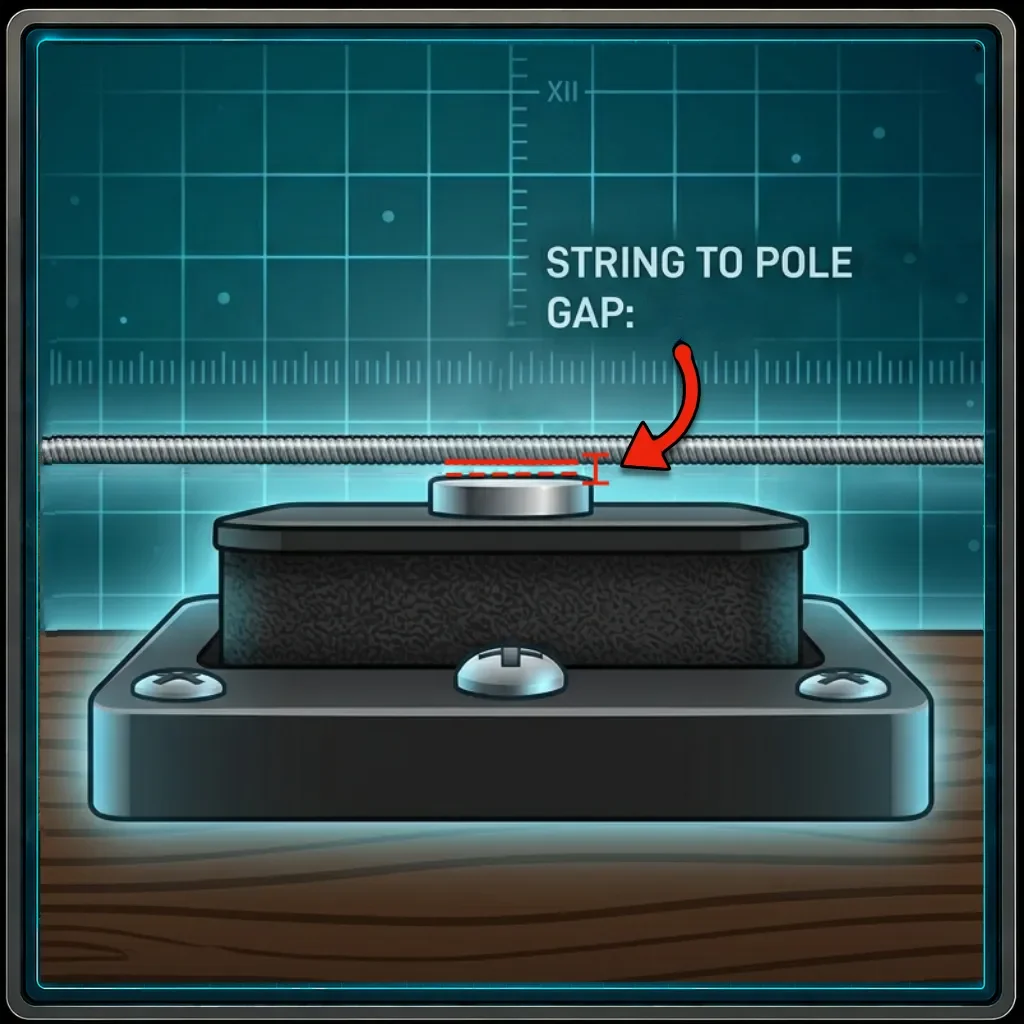
Hold the string down at the last fret — not the 12th, and not open. That puts the string at its closest natural point to the pickup, which is the measurement that matters.
Then measure from the top of the pole piece or magnet to the bottom of the string. A ruler with fine increments works, or a feeler gauge if you have one.
Do the low E and high E separately. They're not meant to match.
Why the bass side sits lower than the treble side
Wound bass strings swing through a wider arc and drive more signal into the pickup. If you set both sides at the same height, the low strings will dominate and the top end will sound thin.
That's why the tool gives you two numbers per pickup — typically a slightly larger gap on the bass side. Setting the pickup parallel to the strings looks tidy and sounds unbalanced.
Bridge and neck are different jobs
Neck pickups sit further from the strings than bridge pickups, for two reasons that stack. The string's vibrating arc is widest nearer the middle of its length, so there's simply more movement happening over a neck pickup. And neck pickups are naturally louder to begin with.
Set the bridge pickup first, since it's the quietest position and effectively sets your ceiling. Then bring the neck pickup up to match it by ear, switching back and forth as you go.
These are starting points, not answers
Every number this tool gives you is a place to begin. Pickup makers publish their own specs and some differ meaningfully — check the spec sheet if you have it. Then trust your ears over the ruler.
Pickup height questions, answered
How high should my pickups be?
It depends on the pickup type and position, which is why the tool asks before answering. As a rough shape: humbuckers sit closest, passive single-coils sit further out — especially in the neck and middle positions — and actives sit around 3mm on both sides. The tool gives you a bass-side and treble-side figure for each.
Where exactly do I measure from?
Hold the string down at the last fret, then measure from the top of the pole piece to the bottom of the string. Measuring with the string open, or at the 12th fret, will give you a number that doesn't match any published spec.
Why are the bass and treble numbers different?
Wound bass strings move through a wider arc and produce more output. Giving them a slightly bigger gap is what keeps the low E from overpowering the high E. A pickup set perfectly parallel to the strings usually sounds bass-heavy.
My guitar sounds warbly or won't sustain. Could the pickups be too close?
Quite possibly. When a pickup sits too close, its magnetic pull interferes with the string's vibration — you get a wavering pitch, odd harmonics, and notes that die early. Lower the pickup a couple of millimetres and listen again. It's most common on neck-position single-coils.
Do active pickups follow the same rules?
Not entirely. Their magnets are much weaker and the preamp handles the output, so they can sit closer without the magnetic pull problems. They still need enough clearance to avoid compression artifacts. One more thing worth checking: a weak battery makes an active pickup sound like it's set wrong, so rule that out before you reach for a screwdriver.