Practice Guide
How to Build a Practice Routine Around Weak Spots
Real progress comes from practicing the exact things that break down. Learn how to build a routine around your weak spots without losing motivation.

We have all had that practice session. You pick up your guitar with the best intentions, promise yourself you are going to work on something new, and somehow end up playing the same familiar lick for half an hour. It feels like practice, but it does not always lead to real progress.
The truth is that progress usually comes from targeting the exact spots where your playing breaks down. If you want to get better faster, you do not need more random hours. You need a clearer plan for finding weak spots and working on them on purpose.
Find the bottleneck
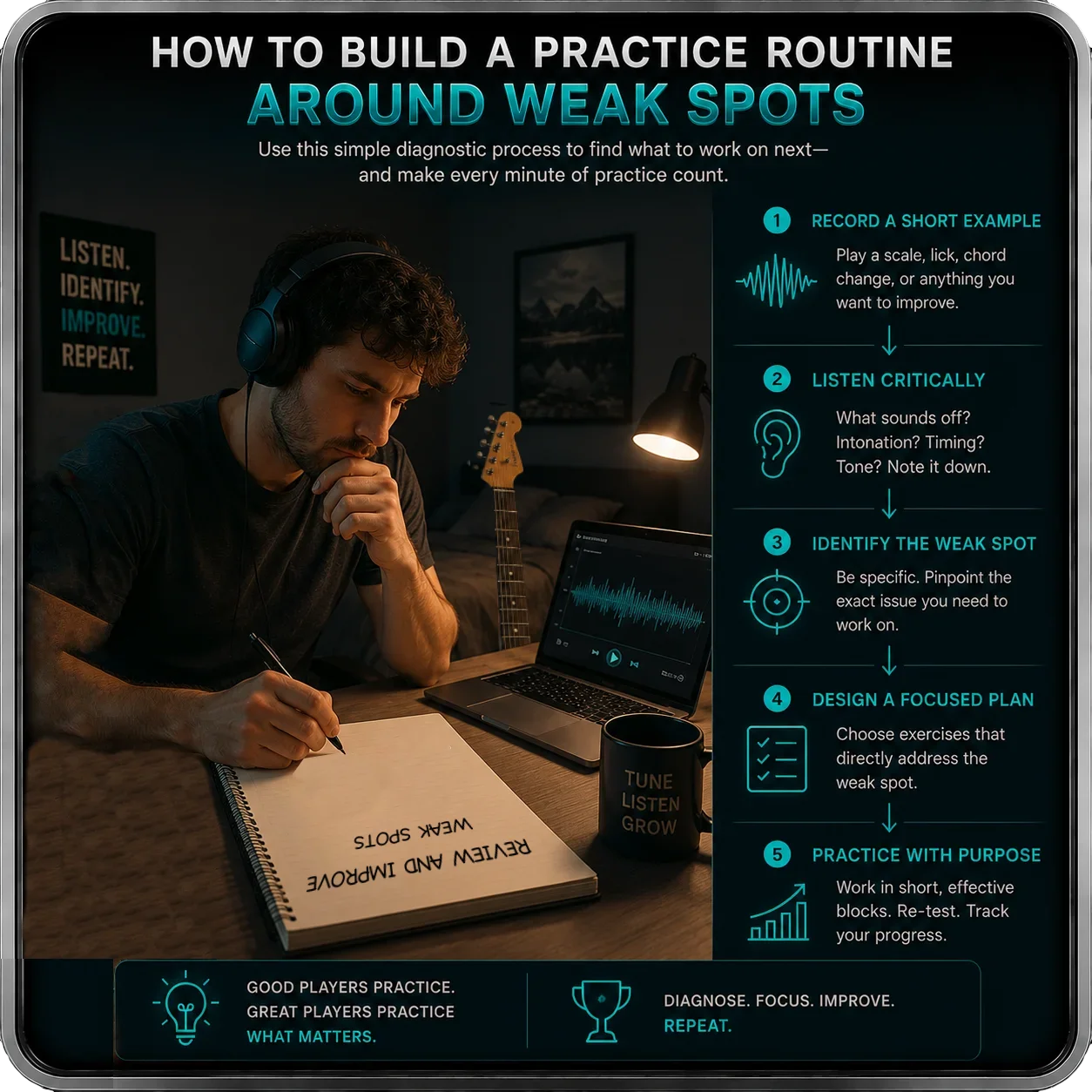
Before you can fix a weak spot, you need to know what is actually breaking down. One of the best ways to do that is to record yourself playing a passage that gives you trouble. When you listen back, look for the exact mechanical issue instead of just saying it sounded bad.
Sometimes the problem is timing between the two hands. Sometimes it is chord switching. Sometimes it is finger movement that is too wide and inefficient. Once you know the bottleneck, your practice gets much more targeted.
Use the 50/50 split
A good practice routine should not feel like punishment. If all you do is grind technical weaknesses, motivation usually drops fast. That is why a 50/50 split works so well.
Spend half your time on deliberate weak-spot work and half your time on musical joy. That means drills, slow reps, and metronome work on one side, and songs, improvisation, or comfort-zone playing on the other. You stay motivated while still moving forward.
Slow reps, metronome drills, chord switching, isolated technique. Hard but productive.
Songs, improvisation, jamming, comfort-zone playing. Keeps motivation alive.

Work in micro-streaks
Consistency matters more than marathon sessions. Short daily practice blocks often beat one long session once a week because your hands and brain get repeated exposure to the movement. That repetition makes the skill settle in faster.
This is especially important for things like chord changes, picking precision, or finger independence. A few focused minutes each day can do more than a single exhausting session. The goal is to build repeatable movement, not just log time.

Track your progress
If you are trying to improve specific weak spots, it helps to keep track of what you worked on and how it felt. Otherwise, it is easy to forget what tempo you were using or which exercise actually helped. A simple practice log keeps the routine honest.
That is where the Guitar Practice Hub comes in. It helps you record your goals, track your tempo gains, and keep an eye on the areas that need the most work. That makes your practice feel less scattered and more intentional.

Want a clearer practice plan? Open the Guitar Practice Hub to log weak spots, track tempo gains, and keep your routine organized.
Open Practice Hub →The Pocket Roady order
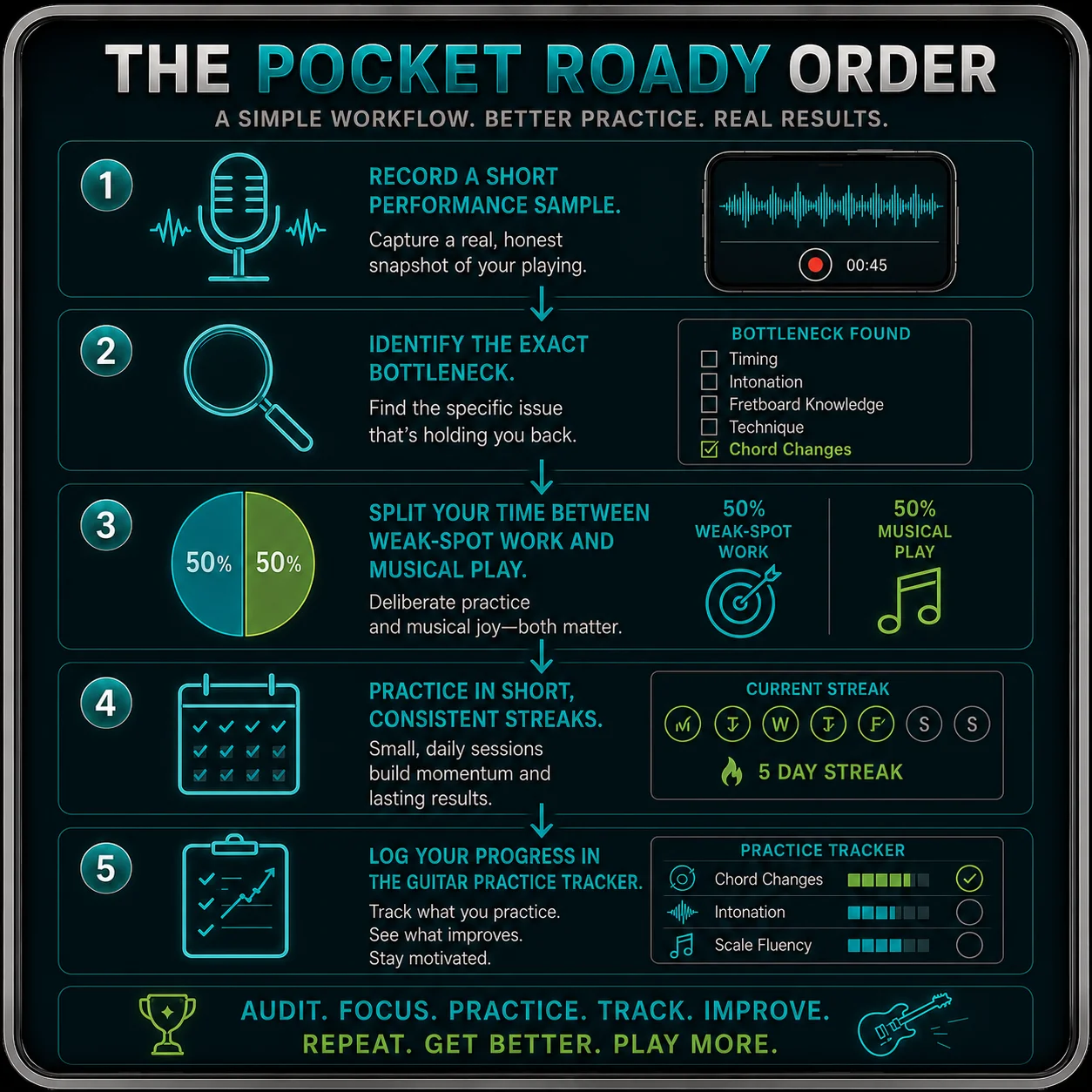
Here is the simplest workflow — start at the top and work your way down:
Record a short performance sample of the passage that is giving you trouble.
Listen back and identify the exact bottleneck — timing, switching, motion size, or something else.
Split your session 50/50 between weak-spot drills and musical play.
Practice in short, consistent streaks. Daily micro-sessions beat occasional marathons.
Log your progress in the Guitar Practice Hub so nothing gets lost between sessions.
You are not trying to fix everything at once — you are building a system that helps your weakest areas improve without draining your love of playing.
Where to go next
If your playing has stalled, the answer is usually not more random practice. It is clearer practice. Once you know what is slowing you down, you can work on it directly and see real gains faster.
Want a clearer practice plan? Open the Guitar Practice Hub to log weak spots, track tempo gains, and keep your routine organized.