Root
Interval
Shapes
Drill
Fret
Pocket Roady
Tool Stack Deluxe
Power
Guitar Interval Finder
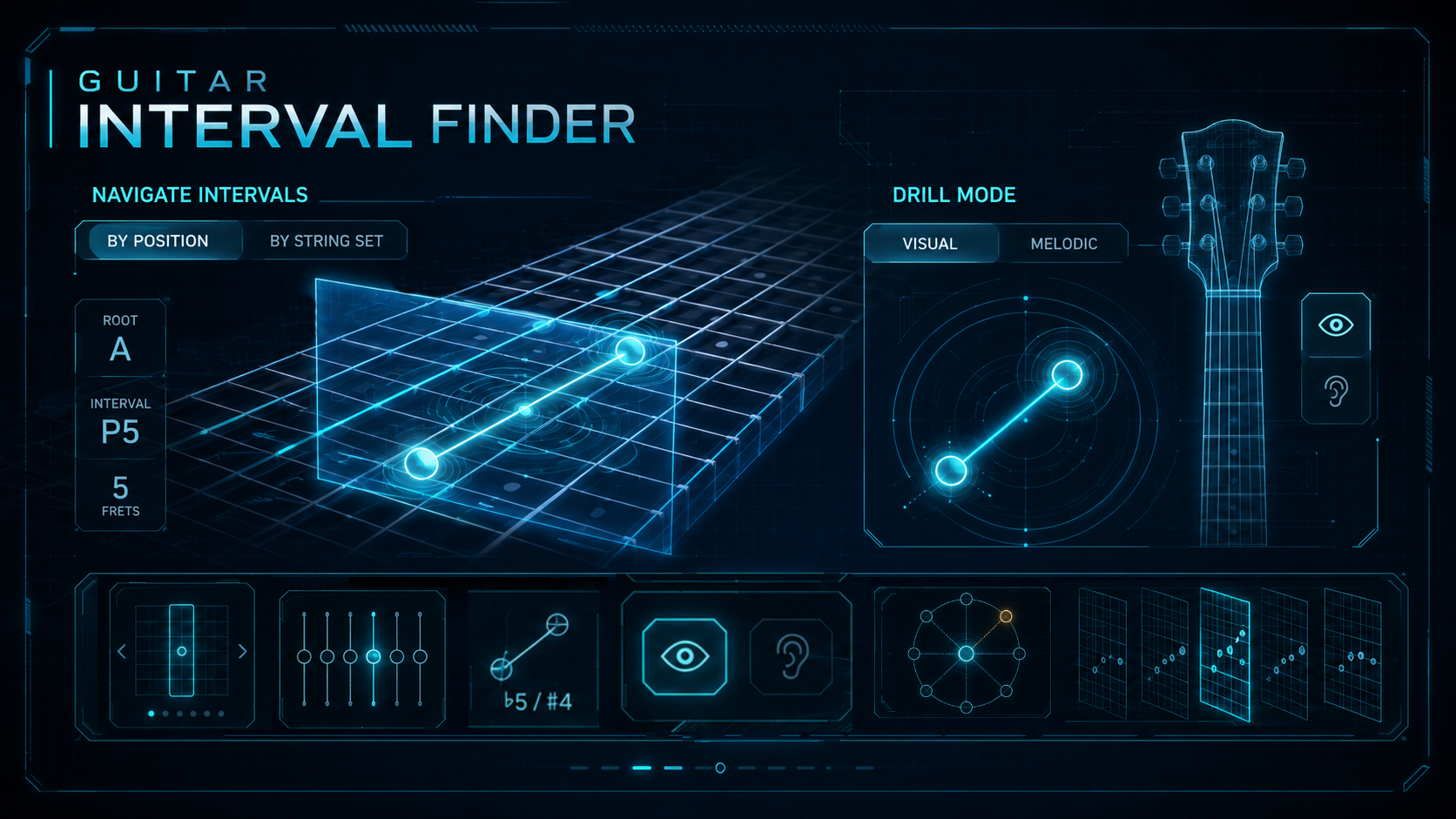
Two notes. Every shape.
Pick a root and an interval. Every playable pair on the neck lights up and gets joined by a line, so the shape lands in your hands — not just your head.
Tap any dot to hear it
Method
Every root on the neck, with its interval partner joined by a line. Colours alternate so neighbouring pairs stay easy to tell apart.
🎸 How to Use This
Level
What interval is this?
0
Streak
0
Best
0
Answered
—
Accuracy
🎸 How to Use This
Good to Know
Interval Finder questions, answered
What is an interval on guitar?
An interval is the distance between two notes, counted in semitones — one fret is one semitone. A major 6th is nine of them. On guitar, every interval also has a shape: a repeatable fingering you can slide around the neck and use in any key.
Why does the same interval have more than one shape?
Because the guitar repeats its notes in several places. The same major 6th can be grabbed on neighbouring strings, or by skipping a string and shifting back a fret. Both sound identical — one is usually easier under the fingers, depending on where you are. Turn on All shapes to compare them side by side.
Why do some intervals disappear near the high strings?
Bigger intervals need either a wide stretch on one string, or a string above the root to land on. Near the top string there is no higher string left, so the tool falls back to the same-string shape when one fits, and quietly leaves the pair out when nothing would be comfortable to play.
What do the amber and teal dots mean?
In Full Fretboard and By Position, the amber dot is the root — the note you picked — and the teal dot is its interval partner, joined by a line so the shape is easy to see. In By String Set there's no single root, so pairs simply alternate teal and amber to keep each one distinct.
What does "By String Set" do differently?
The first two methods start from a single root. By String Set runs a whole scale across two strings, pairing each note with the one a set distance above it — diatonic 3rds, 6ths, and so on. Because it follows the scale, the quality shifts as you climb (some major, some minor), and each pair is labelled with what it actually is. Pairs alternate teal and amber so neighbouring shapes stay clear. It's the classic way to practise thirds and sixths up the neck.
Why does the string set change when I pick a different distance?
Smaller intervals sit naturally on neighbouring strings; sixths and wider fall under the hand better with a string skipped between them. The tool picks the set that keeps the shape comfortable — and because the G and B strings are tuned a little closer than the rest, it quietly adjusts across that pair so the shapes stay playable all the way up.