Practice Guide
How to Build Guitar Picking Speed Without Losing Cleanliness
Speed comes from efficiency, not force. Learn how to pick faster without losing clarity, control, or relaxation.

We have all watched a great guitarist fly across the fretboard and wondered how they move that fast without falling apart. It looks effortless, so it is tempting to sit down, crank the tempo, and force your hands to catch up. That usually backfires.
The truth is that speed is mostly a side effect of efficiency. If your motion is too big or too tense, your playing will always hit a ceiling. Once you learn to move less and stay relaxed, speed becomes much easier to build.
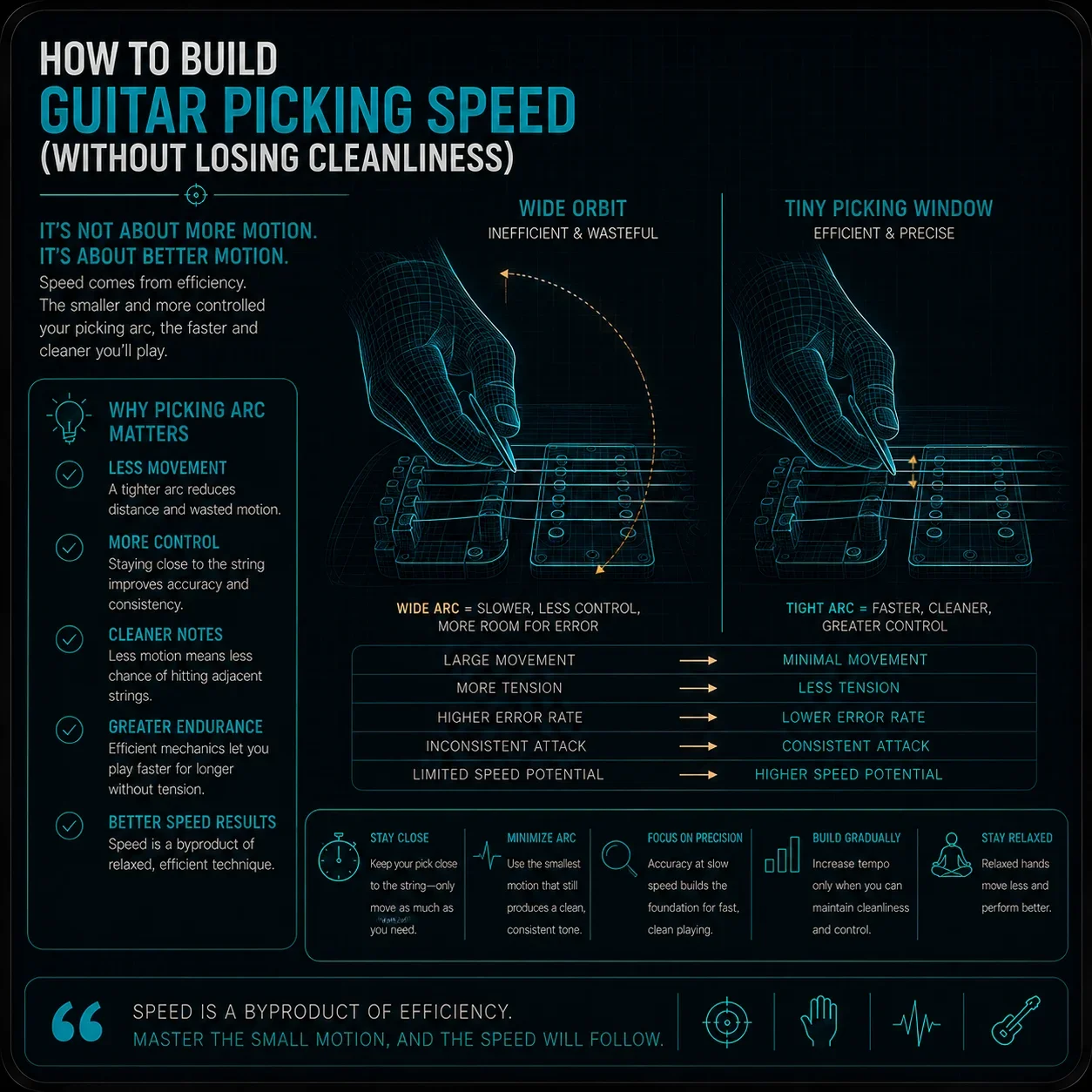
Shrink the motion
One of the biggest speed limits is excessive travel distance. If the pick is moving far away from the strings after every stroke, it has to travel that extra distance over and over again. That wastes energy and slows everything down.
The solution is to keep the picking motion very small. Think of the string as living inside a tiny strike zone. When the motion stays compact, the hand can move faster without feeling like it is working harder.
Slice, don't slap
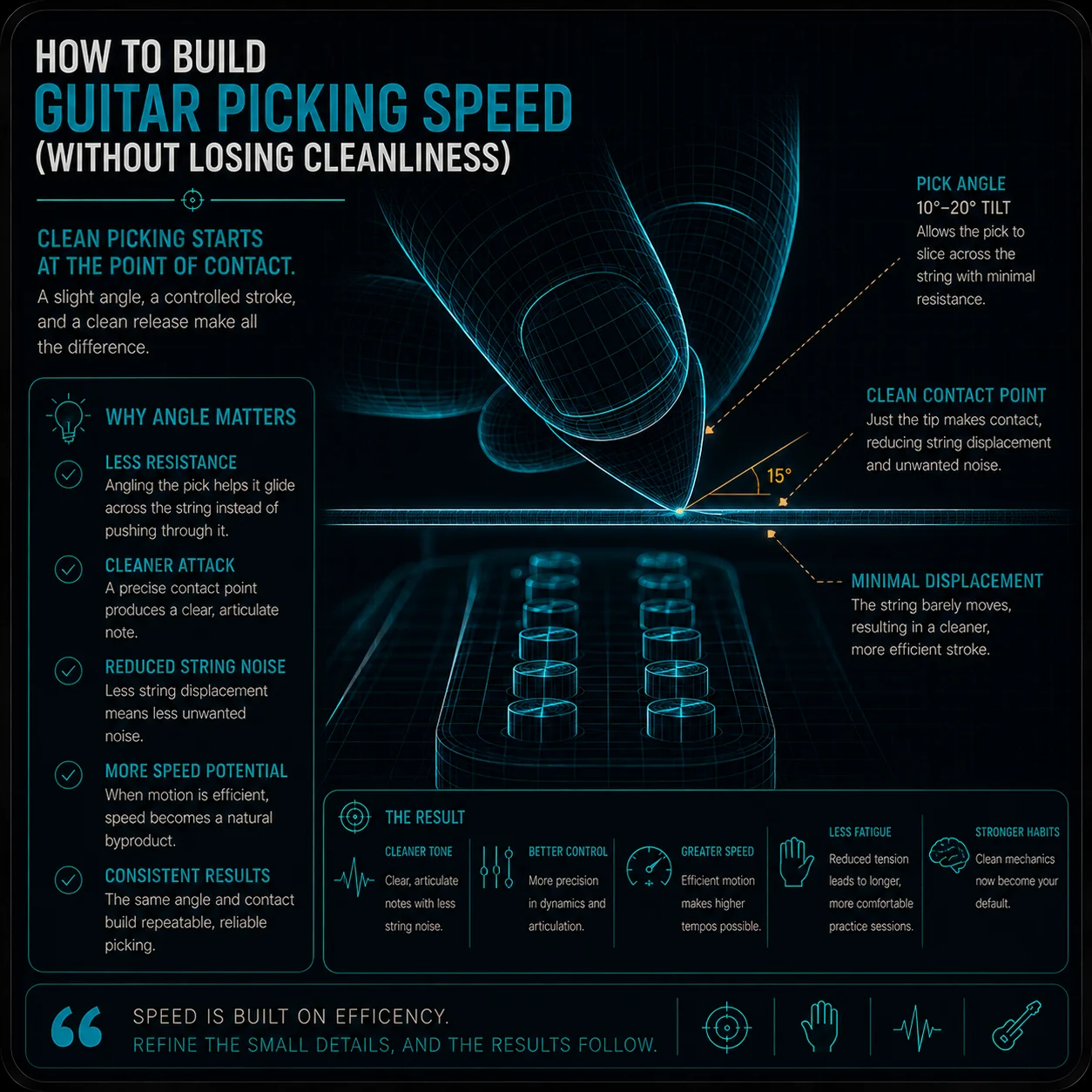
Pick angle matters a lot at higher speeds. If the pick hits the string too flat, it has to push through more resistance. That creates drag, noise, and unnecessary effort.
A slight angle helps the pick slice through the string more cleanly. The motion should feel light and efficient, not heavy and forceful. That small adjustment can make fast alternate picking feel much smoother.
Sync both hands
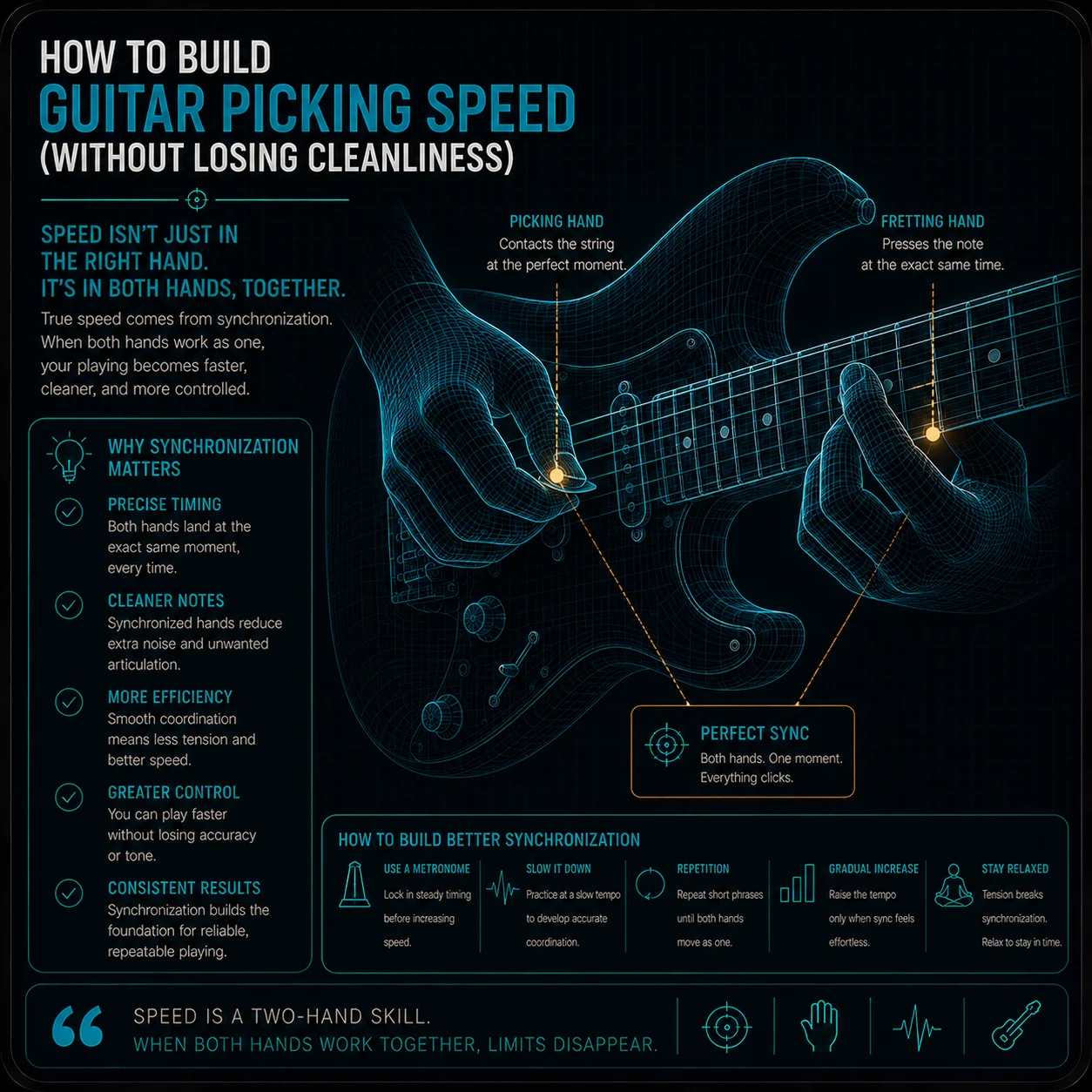
Sometimes the bottleneck is not the picking hand alone. If the fretting hand and picking hand are not landing together, the line can sound choked or uneven. That coordination problem becomes more obvious as the tempo rises.
A good fix is to practice very short, clean bursts instead of long sloppy runs. That gives both hands a chance to lock in without falling apart. Speed grows faster when timing and synchronization are stable first.
Start slow and clean
If you want more speed, slow practice is still the best place to start. When the tempo is low enough, you can hear whether the motion is clean, relaxed, and even. That gives you a usable baseline before you push harder.
This is exactly where the Micro-Groove Metronome helps. It lets you practice slow-and-clean first, then build up in small steps. That makes speed feel like a process instead of a sprint.
Want to build speed the right way? Open the Micro-Groove Metronome to practice slow, clean bursts and ramp your tempo with control.
Open the Metronome →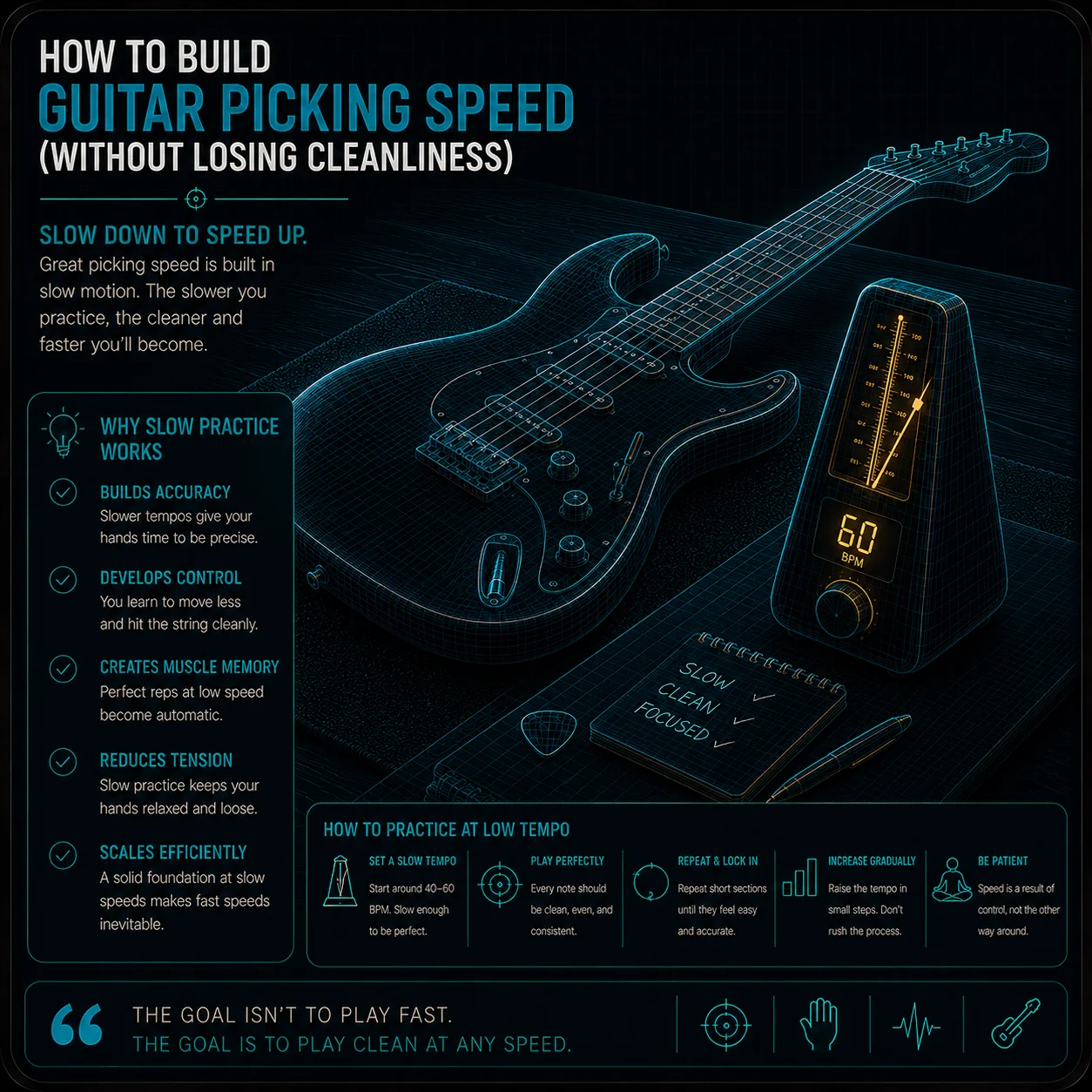
Track your gains
Speed is easier to build when you can see progress. If you are guessing from session to session, it is hard to know whether you are actually improving. A simple log keeps the process honest.
Recording tempos, drills, and weekly progress lets you see what is working. Pairing that habit with the Micro-Groove Metronome gives you a clear path from loose practice to real speed.

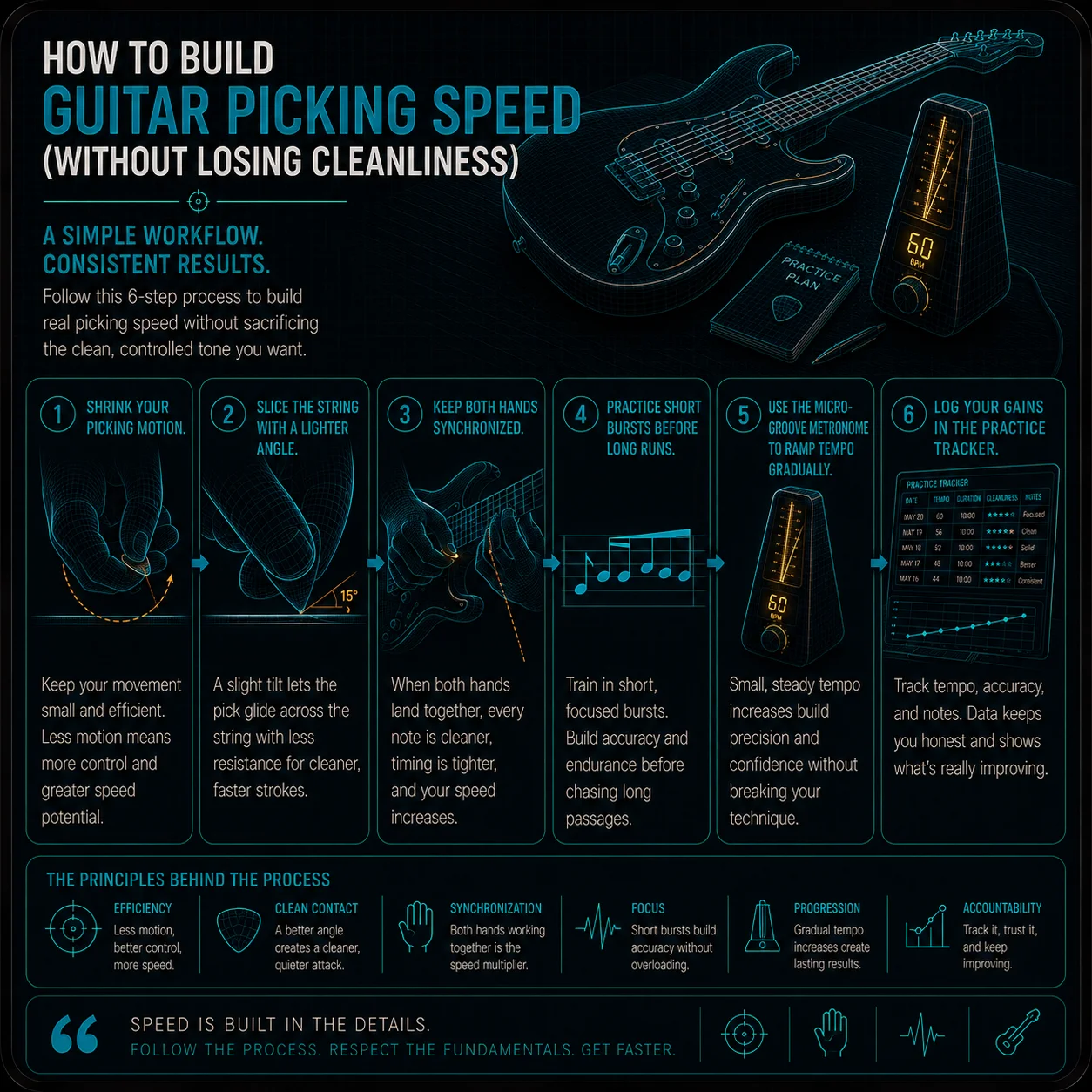
The Pocket Roady order
Here is the simplest workflow — start at the top and work your way down:
Shrink your picking motion. Keep it compact and close to the strings at all times.
Slice the string with a lighter angle. Less resistance means less effort and more speed.
Keep both hands synchronized. Short clean bursts before long runs.
Practice slowly until the motion is clean and relaxed. That is your real starting point.
Use the Micro-Groove Metronome to ramp tempo gradually. Nudge it up only when the previous tempo feels easy.
Log your gains. A simple record of tempos and drills shows real progress across sessions.
Picking speed should feel like better efficiency, not more tension.
Where to go next
If you want to play faster without getting messy, the answer is usually smaller motion and better control. Clean speed is built, not forced.
Want to build speed the right way? Open the Micro-Groove Metronome to practice slow, clean bursts and ramp your tempo with control — or work on the relaxed picking hand that makes speed possible in the first place.