Key
Chords
Partner
Keys
Pocket Roady
Tool Stack Deluxe
Circle of Fifths Navigator
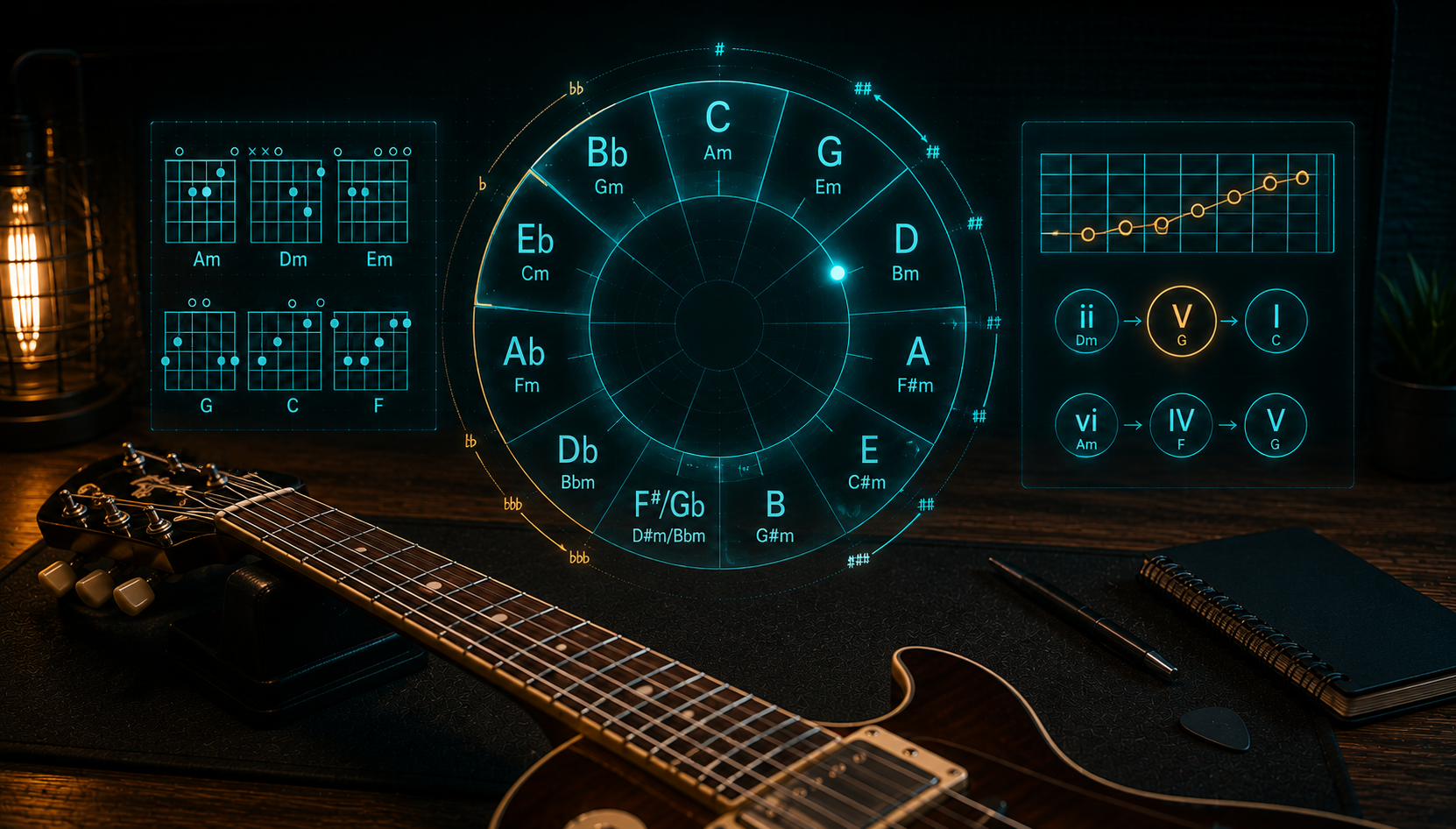
The simplest map of how every key, chord and note connects. Tap any key to see what's inside it — then flip the whole wheel to fourths.
Pick a direction
Major keys (outer)
Minor keys (inner)
Tap any key on the wheel, or any chord in the list, to hear it on guitar.
C major
Notes in this key
Its partner key
Chords that fit together
The outline follows whatever you tap.
Build your own progression
Tap any chord from the list above to add it here. You'll hear each one as it goes in.
100 BPM
Popular progressions
Roady Hint
Every key on this wheel sits right next to its closest neighbours. The two keys either side of yours, plus the three minor keys tucked underneath them, are the ones that sound at home together. That little six-slice pocket is where most songs live — and it's why moving one slice around the wheel almost always sounds right.
Good to Know
Circle of fifths questions, answered
What is the circle of fifths?
It's a map of how the twelve keys relate to each other. Going clockwise, each key sits a fifth above the last — and neighbouring keys share almost all of their notes. That's the useful part: keys next to each other on the wheel tend to sound at home together, which is why so many songs move between them.
What's the circle of fourths, and why would I use it?
Same twelve keys, same relationships — the wheel just runs the other way. Going clockwise in fourths follows the direction chords usually resolve, so it can feel more natural when you're thinking about where a progression is heading. Plenty of players use one or the other out of habit. Try both and keep whichever one reads more easily to you.
What does the partner key mean?
Every major key has a minor key built from exactly the same seven notes, sitting just inside it on the wheel. C major and A minor are the classic pair. Nothing changes but the note you treat as home, which is enough to shift the whole mood from bright to darker. That's why they're shown together rather than as separate keys.
Why do only some slices light up when I pick a key?
The lit pocket is your key plus the slice either side of it, and the three minor keys underneath them. Those six are the chords that live comfortably in that key. It's a handy shortcut: rather than working out the chords note by note, you can read them straight off the wheel.
What does Lock root do?
Normally the outline follows whatever you tap. Lock it and the outline stays on your home key, so you can wander around the wheel listening to other keys without losing sight of where you started. It's useful when you're writing in one key and want to test a chord from outside it.
Why do two keys show two names?
F sharp major needs six sharps, and G flat major needs six flats — exactly as awkward either way, so neither is the “right” one. The same tie carries down to their relative minor, D sharp minor and E flat minor. Those two spots on the wheel show both names. Everywhere else one spelling is clearly simpler, so we just use it: B flat minor takes five flats while A sharp minor would take seven, and nobody writes it that way.