Acoustic Guitar · Setup Guide
How to Improve Acoustic Guitar Saddle Compensation
If your acoustic guitar sounds sour up the neck, the issue may be saddle compensation. Unlike electric guitars, acoustics usually do not have adjustable bridge saddles — so the fix is done by shaping the saddle itself.

That does not mean every acoustic can be made perfect. But many guitars can be improved quite a bit with careful saddle work.
Before you start, make sure the rest of the setup is already in good shape. Fresh strings, proper neck relief, good nut condition, and enough saddle height all matter before you file anything.
Use the Pocket Roady Intonator to check your acoustic compensation before making any permanent changes.
Open Intonation Assistant →Why Acoustic Saddles Are Shaped
When you fret a string, you stretch it slightly. That extra tension makes the note go sharp, so the string needs a little extra length to compensate.
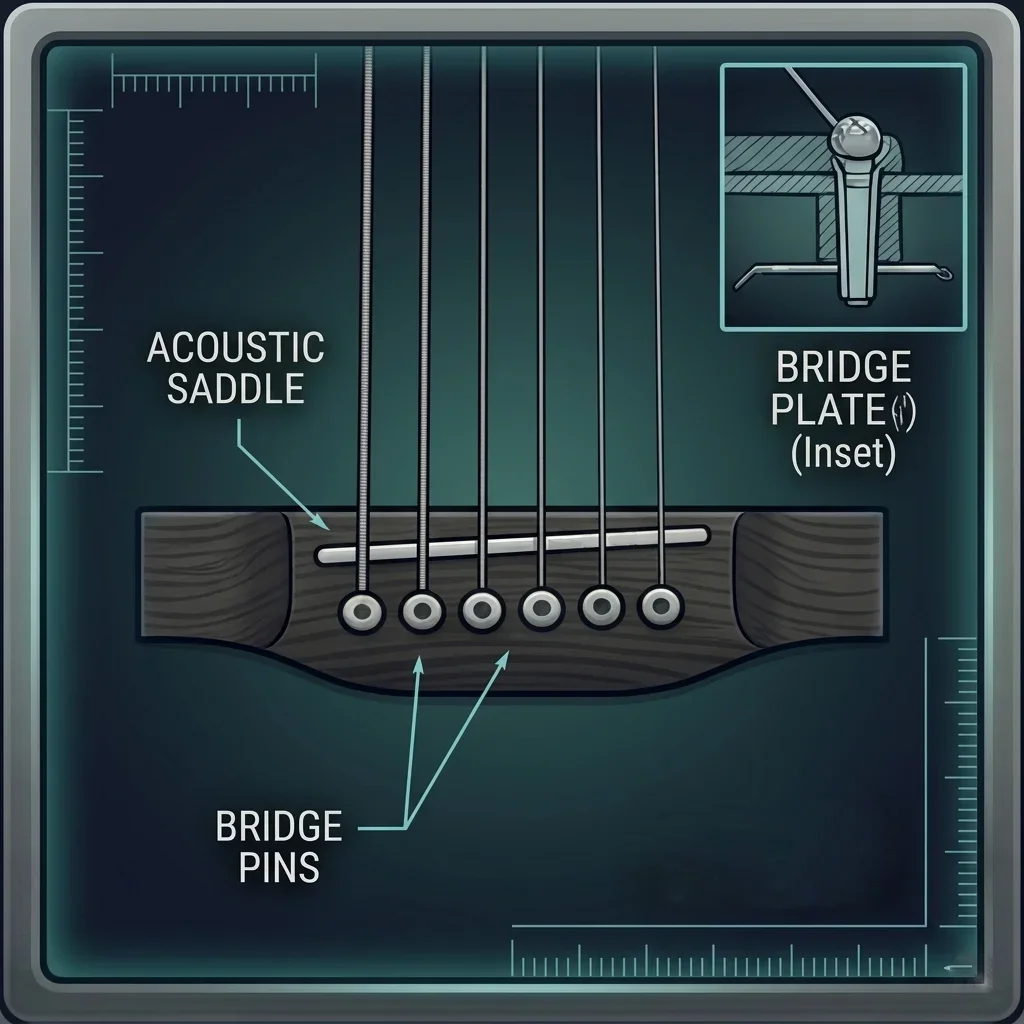
That is why acoustic saddles are often angled or shaped with a compensation pattern. Thicker and thinner strings do not behave the same way, so each string may need a slightly different amount of adjustment.
You may also see a small compensation step or offset for the B string on some saddles. Plain steel strings and wound strings behave differently, so builders often shape that area a little differently.
Step 1: Check Your Strings
Open the Pocket Roady Intonator. Sit in your normal playing position — avoid placing the guitar flat on a table, since that can slightly affect how the neck behaves.
Tune the open Low E string to pitch. Then fret the string at the 12th fret and pluck it.
- Centered needle: the string is in good shape.
- Needle to the right (sharp): the string is too short.
- Needle to the left (flat): the string is too long.
Repeat for all six strings and write down the results.
⚠️ Before filing anything, confirm:
- Fresh strings installed and stretched.
- Proper neck relief — not too much bow or back-bow.
- Nut and fret condition are good.
- Enough saddle height to work safely — filing too low causes buzzing.
Check all six strings with the Intonator and note which need adjustment before touching the saddle.
Check my acoustic intonation →Step 2: Shift the Contact Point
To adjust compensation, you need to move the saddle's contact peak — the highest point the string rests on.
- Sharp note: the string needs to be longer — move the peak back toward the bridge pins.
- Flat note: the string needs to be shorter — move the peak forward toward the soundhole.
Think of it as changing where the string starts its speaking length.
Step 3: File Carefully
If you are new to this, do not start with your factory saddle. A cheap replacement blank is a safer practice piece.
Before filing, slacken the strings and remove the saddle from the bridge slot. Mark the top ridge with a pencil line so you can track the original apex.
Use a small needle file or fine sanding block to remove only a tiny amount of material at a time.
- For a sharp string: file on the soundhole side to move the apex back.
- For a flat string: file on the bridge-pin side to move the apex forward.
Work slowly. Remove a little, reinstall, retune, and recheck. Keep the top ridge narrow and rounded — a flat or wide top can cause the string to buzz or not sit cleanly.
Once you've made your adjustment, use the Intonator to verify the result before reinstalling permanently.
Verify with the Intonation Assistant →When to Stop
If the saddle is already very low, if the guitar still buzzes after filing, or if you are unsure about the result — stop there. A guitar tech can confirm whether the saddle is still the right place to solve the problem.
Sometimes intonation problems also come from the nut, frets, neck relief, or string choice. Saddle work is only one part of the picture.
Final Note
Acoustic saddle compensation takes patience, but small changes can make a real difference. The goal is not theoretical perfection — it is a guitar that plays cleaner, sounds more balanced, and feels more in tune where you actually play it.
Next time you put fresh strings on your acoustic, check the compensation with the Intonator before making any permanent changes.
Not sure if you actually have an intonation problem? The Guitar Setup Assistant can help you figure out where to start — it walks you through the most common setup issues so you know what to tackle first.
New to the fundamentals? The Core Intonation Guide covers how intonation works on any guitar — a good place to start before fine-tuning your acoustic's saddle.
Ready to check your intonation?
Open the Intonator Tool →Looking for Electric Guitar Guides?