Practice Guide
How to Keep Your Picking Hand Relaxed
A relaxed picking hand is the foundation of speed, accuracy, and endurance. Learn how to remove tension without losing control.
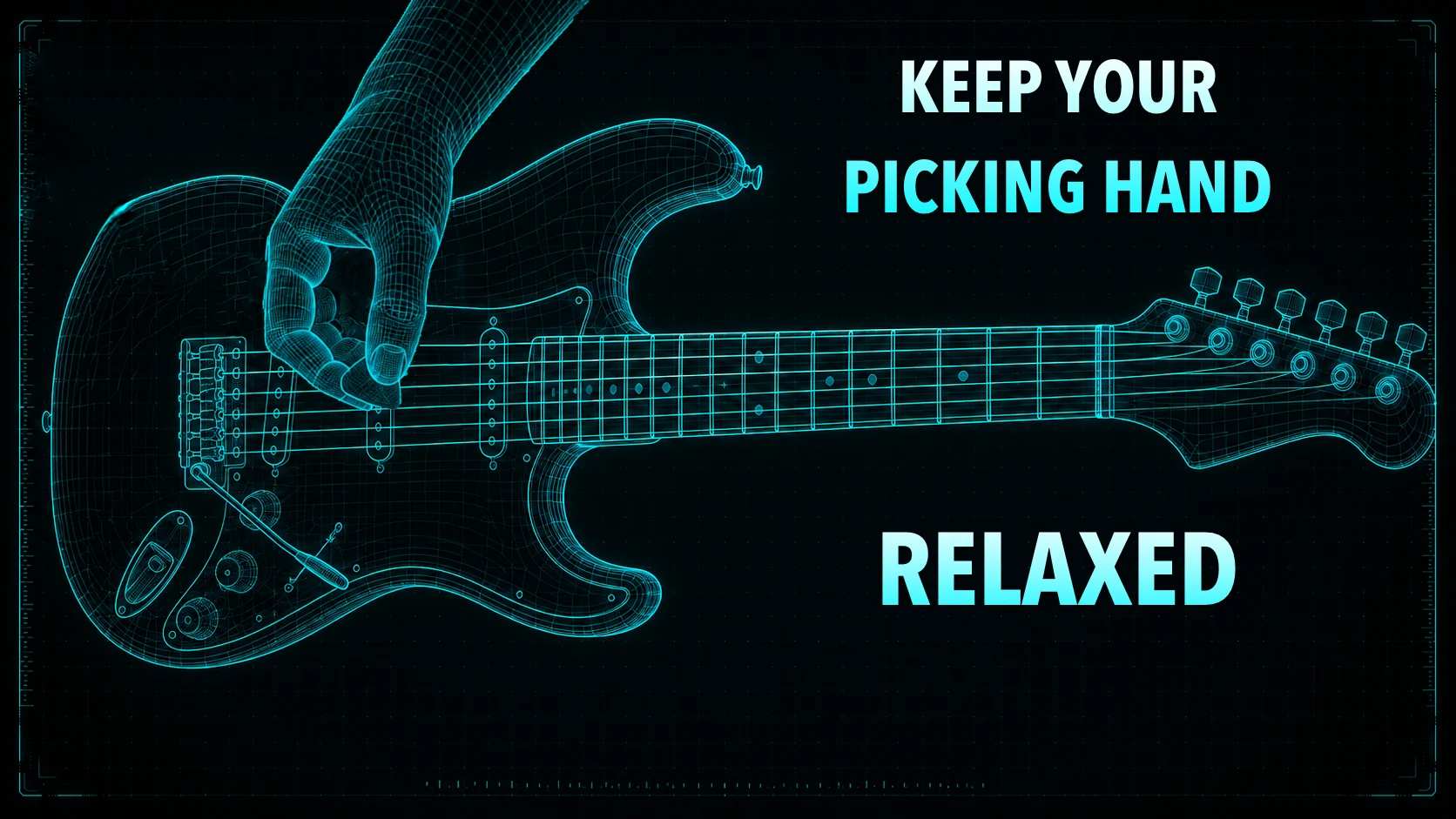
Have you ever noticed that when you try to play a fast riff or a busy strumming pattern, everything feels fine for a few seconds and then suddenly starts falling apart? Your forearm burns, your wrist stiffens, and the pick starts slipping or twisting in your fingers. That is usually not a sign that you need more force.
In most cases, the problem is tension. The fastest players are not squeezing harder — they are staying looser, lighter, and more controlled. Once you learn how to keep your picking hand relaxed, speed becomes much easier to build.
Avoid the death grip
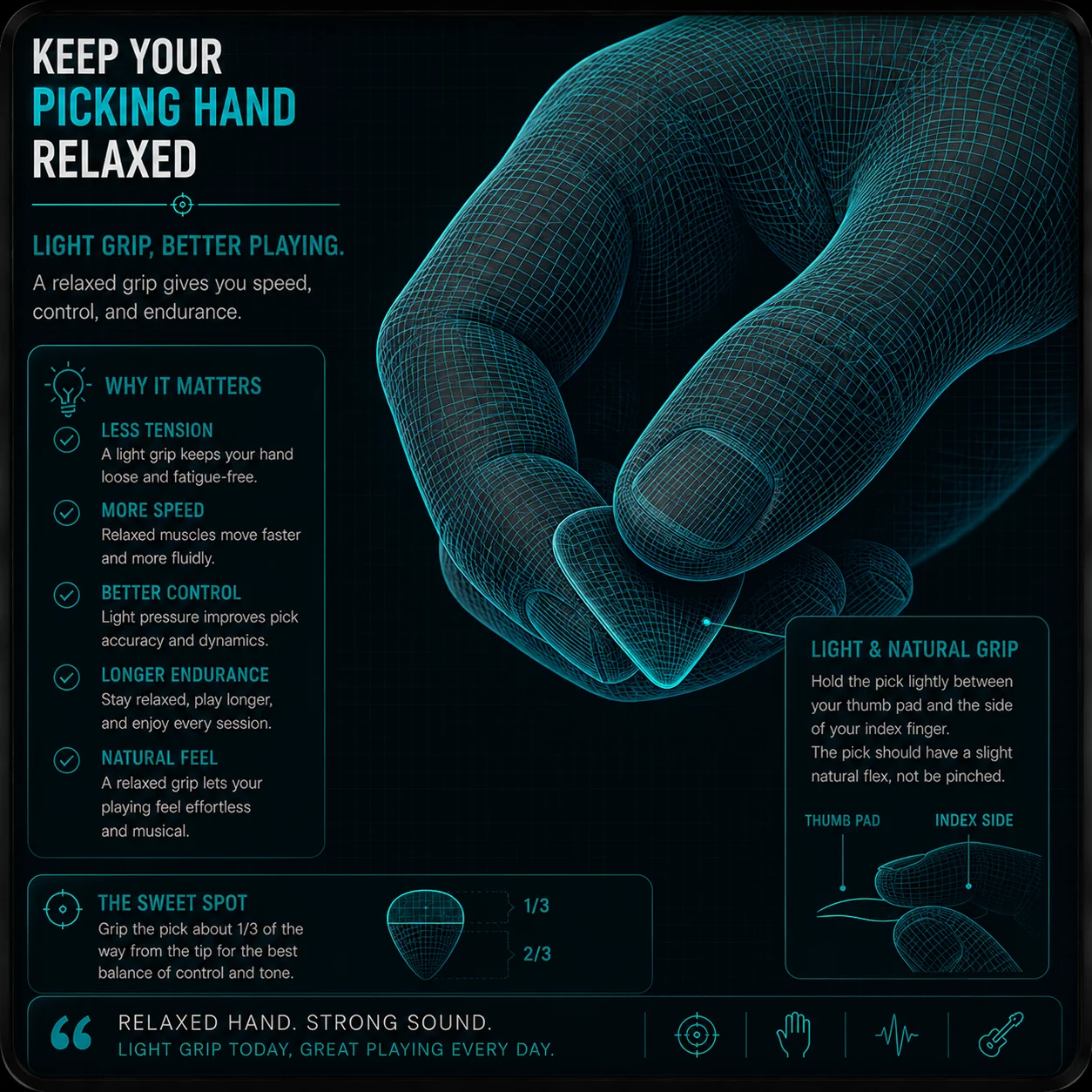
A lot of picking-hand tension starts with how tightly you hold the pick. When a passage gets difficult, it is natural to squeeze harder. But that squeeze usually spreads up into the wrist, forearm, and elbow, making the whole arm lock up.
Hold the pick only as tightly as you need to keep it from flying away. The grip should feel secure, not crushed. A little flex in the pick is usually a good sign that your hand is not overworking.
Let the hand float
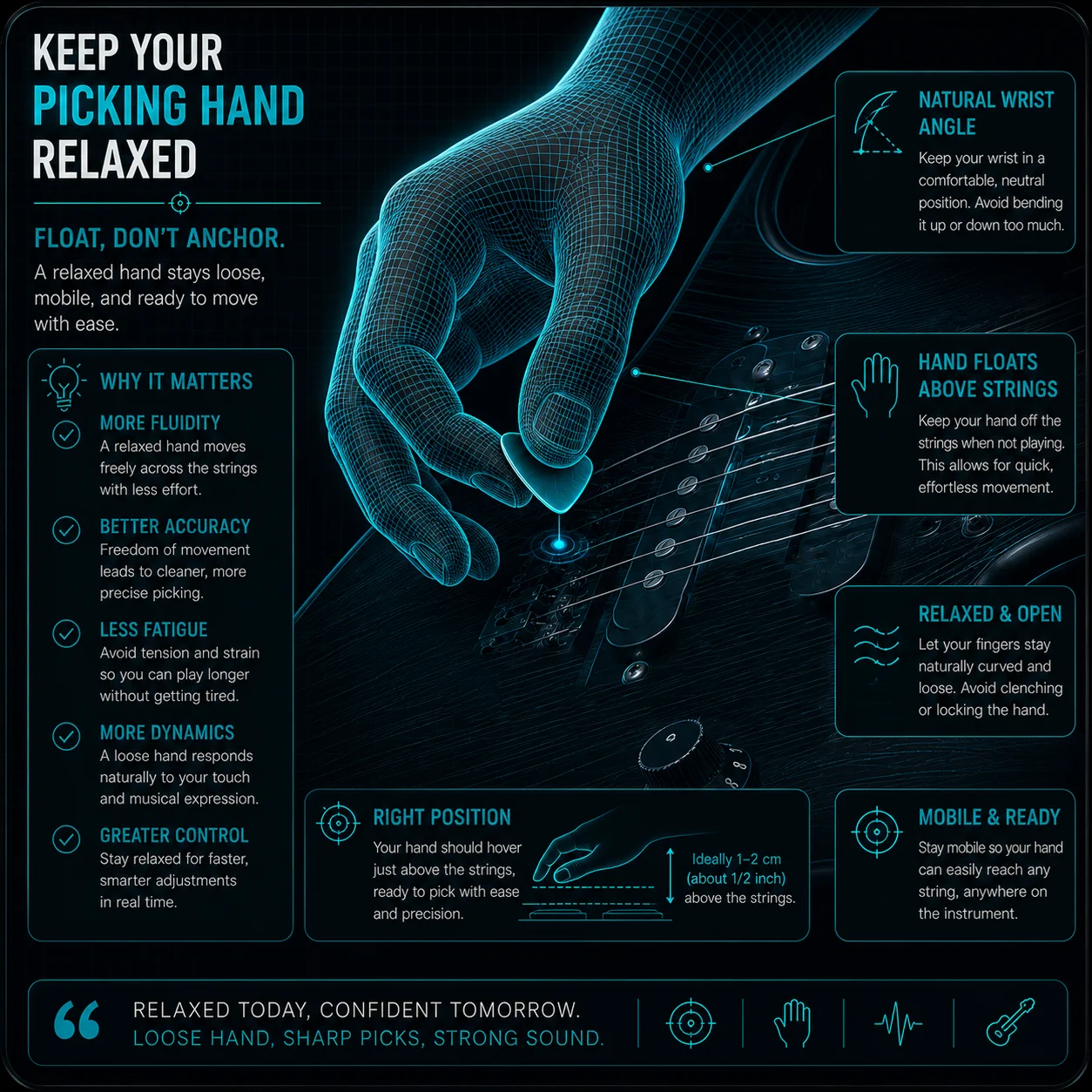
Some players anchor the pinky or plant the heel of the hand too hard on the bridge. That can feel stable at first, but it often traps the hand in one position and creates hidden tension as soon as you move across strings. A lighter, more mobile hand usually plays more efficiently.
Let the hand float or lightly brush the strings for muting control. That keeps the wrist free and makes it easier to stay comfortable as you move between strings. Stability should come from control, not from locking the hand in place.
Move from the wrist
A lot of players accidentally drive the picking motion from the elbow or forearm. That works for a moment, but it burns energy fast and makes the motion feel stiff. The wrist is much better suited to small, efficient picking movement.
Think of the motion as a gentle wrist rotation rather than a big arm stroke. That keeps the motion light, fast, and more sustainable over time. If the wrist is doing the work, the arm can stay calm.
Practice at slow tempo
Relaxation is much easier to learn at a slow tempo. If the speed is too high, your body will naturally tense up to survive the passage. That is why slow, deliberate practice is one of the best ways to rebuild your default motion.
Use a relaxed click or groove track and focus on staying loose the whole time. That is where the Micro-Groove Metronome becomes useful. It helps you build speed from a relaxed baseline instead of from panic.
Want to build speed without locking up? Open the Micro-Groove Metronome and practice slow, relaxed picking until the motion feels natural.
Open the Metronome →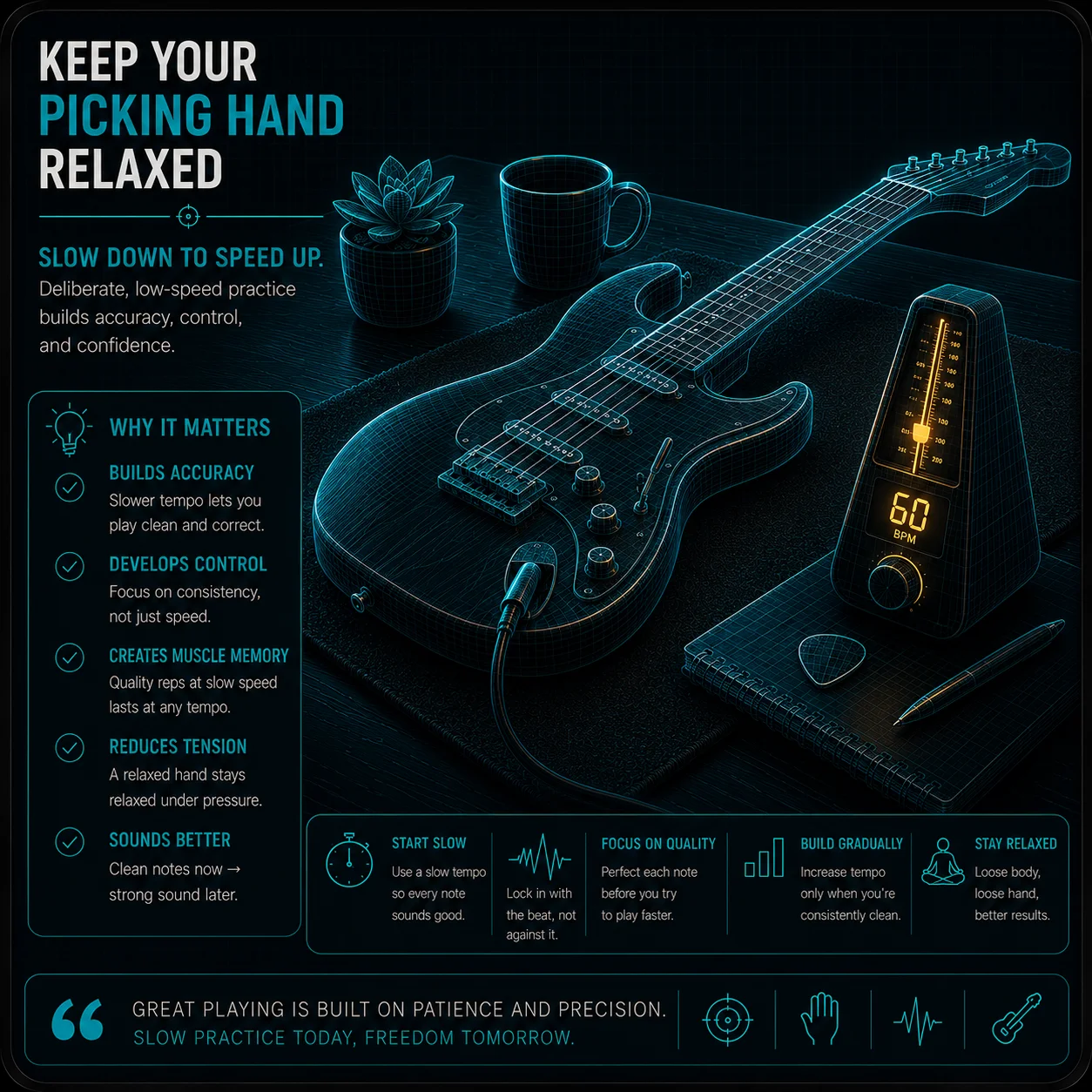
Stay loose with accuracy
Sometimes picking tension shows up because players are trying too hard to force perfect pitch and timing at once. If everything feels like a test, the hand tightens up. That is why a good ear and a good rhythm feel should work together.
As you get more comfortable, your picking should feel less like chasing the string and more like landing naturally on it. If the hand is relaxed, timing and articulation usually improve too. This is where the Guitar Ear Trainer can also help reinforce a calmer, more musical approach.
The Pocket Roady order
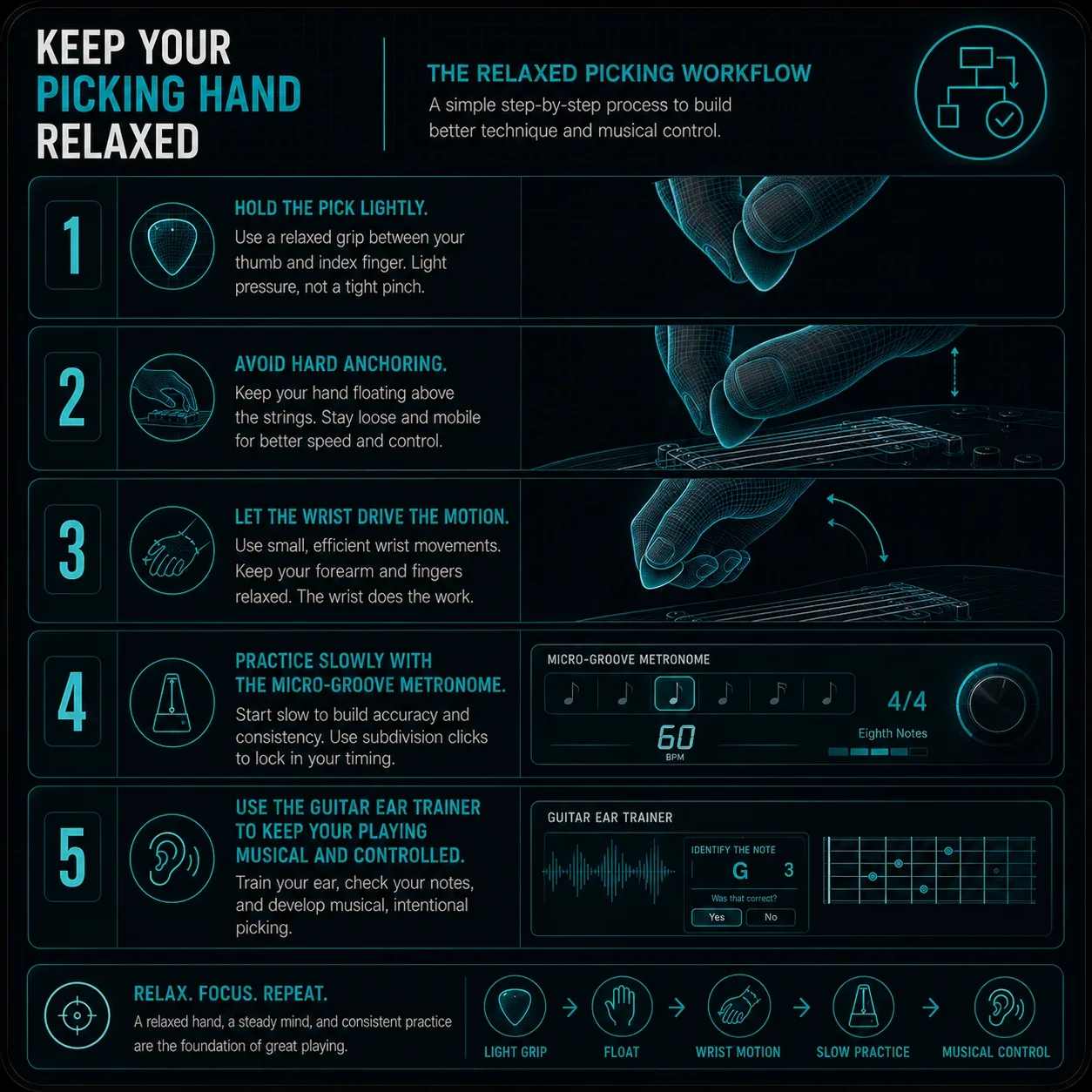
Here is the simplest workflow — start at the top and work your way down:
Hold the pick lightly — secure enough to keep it, not tight enough to squeeze.
Avoid hard anchoring. Let the hand float freely across the strings.
Let the wrist drive the motion. Keep the arm calm and the stroke compact.
Practice slowly with the Micro-Groove Metronome. Build speed from a relaxed baseline.
Use the Guitar Ear Trainer to keep your playing musical and controlled, not mechanical.
A relaxed picking hand is not about doing less — it is about wasting less energy.
Where to go next
If your picking hand locks up, the answer is usually not more force. It is less. Small changes in grip, wrist motion, and tempo can make your playing feel dramatically easier and more fluid.
Want to build speed without locking up? Open the Micro-Groove Metronome and practice slow, relaxed picking — or try the Guitar Ear Trainer to build a calmer, more musical feel.